Census data is already in for a couple of dozen states, and already blogs are starting to speculate about their lessons for American cities. Some commentators look at the continued decline of Rust Belt cities like Chicago and St. Louis, and suggest that suburban sprawl continues (and will forever continue) unabated. But reality is not quite so simple.



Census data is already in for a couple of dozen states, and already blogs are starting to speculate about their lessons for American cities. Some commentators look at the continued decline of Rust Belt cities like Chicago and St. Louis, and suggest that suburban sprawl continues (and will forever continue) unabated. But reality is not quite so simple.
When commentators argue about whether cities can compete with their suburbs, they don't really mean "all cities"; instead, I suspect they mean "cities that have been losing population to their suburbs." So in examining the early returns from the Census, I focused on two groups of cities: declining cities (those that have lost population since their post-WW II peak) and formerly declining cities (those that have lost population in at least one post-1950 decade, but have recovered and are now more populous than in 1950).
By my count, the Census has issued population data for only nine declining cities with over 200,000 people: Chicago, Baltimore, Washington DC, St. Louis, Newark, Jersey City, Birmingham, New Orleans, and Norfolk. Four of these cities actually gained population in the 2000s: Washington, the two New Jersey cities, and Norfolk- and in three of the cases (all but Jersey City) the city gained population for the first decade since 1970. So if anything, there has been a modest "back to the city" movement in some cities. On the other hand, one city that had gained population in the 1990s (Chicago) slipped backwards.
A second category of formerly declining cities slipped in the mid-20th century, but started to gain population in the last decade or two of that century. This category includes Indianapolis, Fort Worth, Kansas City, Seattle, Denver, Portland, Omaha, Winston-Salem, and Baton Rouge. Not one of these "comeback cities" lost population; it appears that once a city regains its appeal, it keeps growing again. (Caveat: I am sure some of these cities grew by annexing their suburbs).
Of course, all of this could be balanced out by population losses among growing cities. Among cities that consistently gained population in the last half of the 20th century, census data is available for Houston, San Antonio, Dallas, Austin, Charlotte, El Paso, Las Vegas, Oklahoma City, Raleigh, Colorado Springs, Tulsa, Arlington (Texas), Wichita, Aurora, Corpus Christi, Plano, Greensboro, Lincoln, Durham, Laredo, Lubbock, and Garland. Only one of these cities (Tulsa) lost people in the 2000s, and by the narrowest of margins (about 2000 people).
So far it appears that the 2000s has been a better decade for cities than the last decades of the 20th century- albeit not the complete reverse of suburbanization that some pundits appear to yearn for. Not every declining city gained population, but on balance there were more winners than losers, and more winners (if "winning" is defined as "gaining population")* than in prior decades.
Another issue that I find interesting is the relationship between mid-decade Census estimates and the 2010 Census. As yearly Census estimates came in over the past decade, commentators battled over their meaning. Does it matter if a Census estimate in year X shows more big cities growing? Or does it matter more if the trend appears to be reversed in year Y?
Intercensal estimates were not consistently wrong in any one direction. The 2009 estimates showed Chicago and St. Louis growing- results quite contrary to the 2010 Census. But in some cities (such as Washington and Newark), the 2009 Census estimate came within a couple of thousand people of the 2010 result. And the 2009 estimate failed to catch Norfolk's growth, and underestimated Charlotte's growth by 20,000 people. So on balance, the best one can say about intercensal estimates is that they have a margin of error of as much as 11 percent (the amount by which the Census overestimated the 2009 populations of St. Louis and Omaha).
*One could also define "winning" as increased income. This issue I shall address in some future post, I hope.


Diverse on Paper, Segregated in Reality
Many places are statistically diverse, but their inhabits can be worlds apart. A local perspective (and finer data) is needed to fully appreciate how different races and classes inhabit a neighborhood.
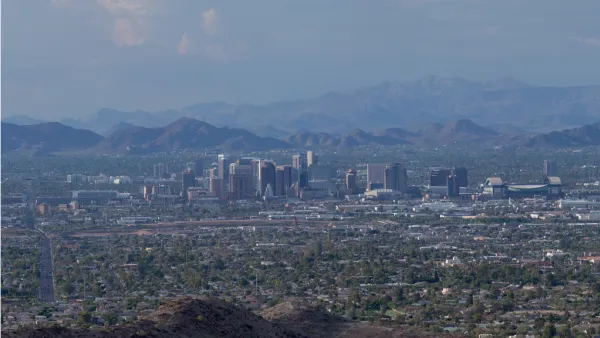
The Changing Shape of American Cities
A newly released report shows the demographic transformation of American cities spatially from 1990 to 2012 by charting their neighborhoods based on distance to the center of the city.
More Evidence for the 'New Donut' Model of Metropolitan Areas
Spatial analysis of income and education over time in U.S cities provides further evidence for the “New Donut” theory of the city. Wealthier and more educated residents are more likely to move to the urban core or exurbs than to inner-ring suburbs.

‘Going backwards:’ Baltimore mayor, students rally against state's transit funding plan
Maryland's proposed six-year plan provides no funding for Baltimore’s BMORE bus program and reduces its road maintenance funding.

Detroit to transform waterfront with $2.2 billion investment
Developers will convert about 18 acres of unused parking lot space into civic spaces.
Mamdani sent nearly 6,000 pied-à-terre tax warnings to homes that didn’t qualify
A judge has ordered the administration to cancel thousands of pied-à-terre tax notices after it sent 35% of them erroneously.

25 states, cities sue the EPA over erased power plant emissions limits
The coalition also intends to sue the EPA for not regulating emissions from gas-fired power plants.

Newsom vetoes giving CA tribes greater voice in water projects
In his veto letter, Newsom said the bill would add ‘uncertainty’ to the state’s fight to secure Californians’ water supplies.

Michigan Senate votes to revise 'lax' dam safety laws
A Bridge Michigan investigation found more than 100,000 Michigan residents live in the floodpath of a high or significant-hazard dam.

FREE Course: Walkable City 1: Why Walkability?
After describing his path towards focusing on walkability as the essence of good planning, Jeff Speck marches through his five principal reasons for making more walkable places.
Reinventing Malls: Planning Alchemy—Turning Gray Fields Into Gold
The course focuses on the opportunities and imperatives that shape reinvention of mall sites.

City of Thousand Oaks
City of Wisconsin Rapids
Harvard University Graduate School of Design
The Architects Foundation
University of Cincinnati Online
Northern Illinois Transit Authority (NITA)
The Pocatello Development Authority
The Urban Renewal Agency of the City of Pocatello

