Was Leonardo a proponent of sprawl? The Renaissance man evidently believed the congestion of cities caused plagues in Milan in the 1480s, and drew up plans for a new city with wide streets and a network of canals.


Da Vinci's plans were a "radical departure from the organic fabric of the medieval city," writes Anamika Mishra:
Circulation was a predominant theme in Leonardo's proposals, whether related to people, freight or waste. This was articulated by straight roads in a grid iron pattern and the extensive use of waterways as a means of circulation.
Leonardo's proposal for segregating the various aspects of a city, in order to maintain sanitation created a very tangible functional zoning, an attribute adopted centuries later by modernist urban planners."

A map of Milan, drawn by Da Vinci in his Codex Atlanticus
Read the full story: Leonardo da Vinci's Ideas on Town Planning
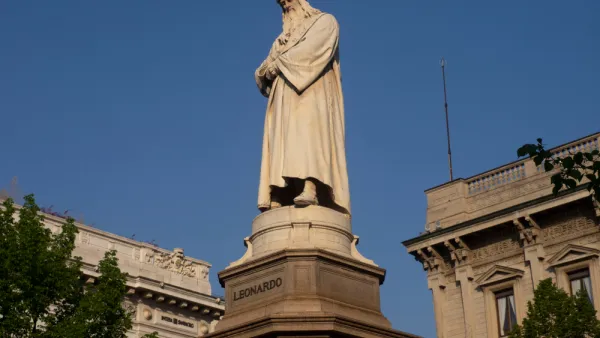
Leonardo da Vinci and Urbanism
Leonardo Da Vinci gets credit for many inventions and creative breakthroughs, but his contributions to the theory of city making gets less credit.

World's Oldest New World Globe Found on an Ostrich Egg
A collector has discovered the world's oldest globe to depict the New World, which may have originated from Leonardo da Vinci's shop in 1504.

Planetizen Federal Action Tracker
A weekly monitor of how Trump’s orders and actions are impacting planners and planning in America.

Washington state to charge fee to drivers with fuel-efficient cars
Revenue from the fee will go towards supporting the state’s highways.

Illinois considers spending $1 billion in taxpayer money on data center
A quantum computing campus and data center are currently under construction in Chicago.

People Mover delayed again, LAX and contractor trade barbs
The automated train was last slated to open in January 2027.

Trump to blast ‘hydrocarbon highway’ through ‘world’s longest art gallery’
Environmental and historic preservation groups are suing to stop the project.

25 states cast bids to be the home of U.S. Space Academy
The academy will train scientists, officers and astronauts for the U.S. Space Force.

FREE Course: Walkable City 1: Why Walkability?
After describing his path towards focusing on walkability as the essence of good planning, Jeff Speck marches through his five principal reasons for making more walkable places.
Reinventing Malls: Planning Alchemy—Turning Gray Fields Into Gold
The course focuses on the opportunities and imperatives that shape reinvention of mall sites.

City of Charlotte
City of Rosemead
Rutgers University, Edward J. Bloustein School of Planning and Public Policy
University of Michigan School for Environment and Sustainability (SEAS)
Hunter College, City University of New York (CUNY)
The Architects Foundation
University District Partnership