"More cities in the developed world shrank than grew in the last three decades. More than 40 of those cities were in the United States, according to City Mayors, an urban affairs think tank," writes Gordon Young.


Dan Kildee believes, "shrinking cities must accept that they're not going to regain their lost populations anytime soon." Abandoned buildings must be leveled and replaced with parks, green and public spaces if new occupants cannot be found. "But demolitions are just part of the plan. He says the "genius" of his approach is that it implements a regional land use strategy that redistributes real-estate wealth."
It is an approach pioneered in Germany after reunification, where there was a mass exodus from eastern cities as people moved to the more prosperous west. Kildee has received considerable criticism for his plans, which appear to run "counter to America's can-do spirit, its reputation for boundless optimism." It is difficult for elected officials to back a plan that essentially requires citizens to lower their expectations.
"But popularity doesn't equal good policy," concludes Kildee.
Read the full story: The Incredible Shrinking American City
Flint, Michigan, Declares ‘War on Blight’
Flint Mayor Dayne Walling used the occasion of his recent State of the City speech to call for a $70 million “war on blight” that would include the demolition of 6,000 buildings.
Next Steps for Shrinking Cities: Results of the Planetizen Brainstorm
Bulldoze? Densify? Walk away? There are many ways cities can react to shrinking populations and abandoned neighborhoods. Planetizen readers decide which ways are the best.
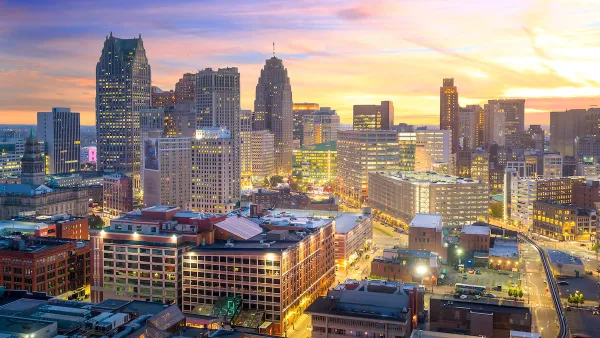
Detroit and Michigan on the Upswing
It's been 66 years since the Motor City last grew its population. Census data released last month revealed an increase of nearly 2,000 people last year, nearly half the state's population growth.

Planetizen Federal Action Tracker
A weekly monitor of how Trump’s orders and actions are impacting planners and planning in America.

Eastern Nebraska is running out of electricity
Data centers and electrification are straining eastern Nebraska’s grid, throttling economic development.

Study reveals best places in the U.S. for cycling, walking
New research from Streetlight Data examines bicycle and pedestrian miles per capita in the 100 largest U.S. cities by population.

DSA members accuse Mamdani of 'abandoning values' over housing redevelopment
New York City's mayor plans to replace about 2,000 units of public housing with private, mixed-income housing.

All sides of BRT debate unhappy with CDOT’s most recent move
The Colorado Department of Transportation is no longer considering center-running bus lanes for Colorado Boulevard.

Massachusetts bogs generate both power, and cranberries
Putting solar panels above farmland is one way Massachusetts is advancing toward its goal of net-zero carbon emissions by 2050.

FREE Course: Walkable City 1: Why Walkability?
After describing his path towards focusing on walkability as the essence of good planning, Jeff Speck marches through his five principal reasons for making more walkable places.
Reinventing Malls: Planning Alchemy—Turning Gray Fields Into Gold
The course focuses on the opportunities and imperatives that shape reinvention of mall sites.

City of Rosemead
Rutgers University, Edward J. Bloustein School of Planning and Public Policy
One Hundred Miles
University of Michigan School for Environment and Sustainability (SEAS)
Hunter College, City University of New York (CUNY)
The Architects Foundation
City of Cambridge
The Pocatello Development Authority
The Urban Renewal Agency of the City of Pocatello