Columnist Jeanne Haffner goes hands-on to learn how graphic representation is used in the day-to-day work of planning.


She joins Ryan Sullivan, a designer and planner at Boston-based Utile, Inc. They explore the importance of abstract graphic representation.
"My goal was to understand the importance of graphic representation in his day-to-day work. As an example, Sullivan pointed to the Stuart Street Planning Study, a project that Utile carried out for the Boston Redevelopment Authority (BRA) in 2007-2008. By examining this specific case, I came to understand that graphic representation not only helps designers like Sullivan analyze a particular problem or set of problems. It also aids them in constructing a coherent narrative and convincing argument about the area at hand that can be easily communicated to others-a crucial part of the planning process."
Read the full story: Making Stuart Street


How Data is Helping Protect Campus Trees
The University of Alabama at Birmingham is using GIS technology, student engagement, and sustainability-driven planning to manage and protect its nationally recognized urban forest.

Trump Cuts Decimate Mapping Agency
The National Geodetic Survey maintains and updates critical spatial reference systems used extensively in both the public and private sectors.
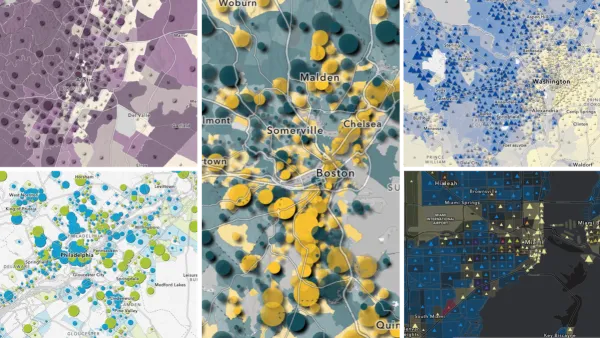
Explore US Demographics With the New ACS Atlas Collection
Esri's new ACS Atlas Collection offers interactive applications that visualize the latest U.S. demographic and socio-economic data, enabling users to explore over 175 curated web maps across various thematic areas.

Planetizen Federal Action Tracker
A weekly monitor of how Trump’s orders and actions are impacting planners and planning in America.

‘Going backwards:’ Baltimore mayor, students rally against state's transit funding plan
Maryland's proposed six-year plan provides no funding for Baltimore’s BMORE bus program and reduces its road maintenance funding.

Detroit to transform waterfront with $2.2 billion investment
Developers will convert about 18 acres of unused parking lot space into civic spaces.

HUD, USDA agree on framework to simplify housing environmental review standards
Their agreement is a requirement of the 21st Century ROAD to Housing Act.

Cost of water rising at a faster pace than inflation, median household income
California and Maryland residents have seen their water bills grow especially high.

NYC building owners overwhelmingly comply with new emissions limits
The New York City Department of Buildings is fining owners who did not file emissions reports.

FREE Course: Walkable City 1: Why Walkability?
After describing his path towards focusing on walkability as the essence of good planning, Jeff Speck marches through his five principal reasons for making more walkable places.
Reinventing Malls: Planning Alchemy—Turning Gray Fields Into Gold
The course focuses on the opportunities and imperatives that shape reinvention of mall sites.

planning NEXT
City of Thousand Oaks
City of Wisconsin Rapids
The Architects Foundation
University of Cincinnati Online
Northern Illinois Transit Authority (NITA)
The Pocatello Development Authority
The Urban Renewal Agency of the City of Pocatello