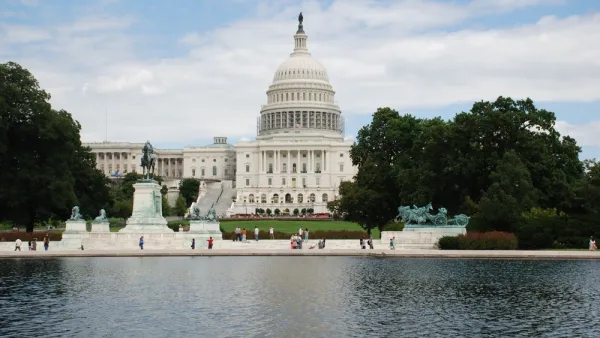
The Senate will introduce on Sept. 30 its companion bill to the Waxman-Markey climate change legislation that has already passed the House of Representatives. Both bills rely on 'cap & trade' to meet their greenhouse gas emission reduction targets.


Last May, the House passed historic legislation aimed to reduce greenhouse gas emissions. Now the Senate will continue the process, though arriving at a filubuster-proof 60 votes is considered to be more of a political struggle.
"The legislation will outline a tougher near-term target for cutting greenhouse-gas emissions but won't include how valuable pollution credits will be distributed among affected industries. Most of the political fights in the House were over the distribution of those credits, valued at tens of billions of dollars a year.
Sen. Barbara Boxer (D., Calif.), chairwoman of the Environment and Public Works Committee, is using the landmark legislation passed by the House in June as a
template for her own bill, but has strengthened the 2020 emissions target. Instead of a 17% reduction of gases from 2005 levels by 2020, she will be seeking a 20% reduction."
Thanks to Patricia Matajcek
Read the full story: Senate to Unveil Climate-Bill Blueprint Wednesday


Historic Climate Legislation Included in COVID Relief Spending Deal
The $900 billion COVID relief bill along with a $1.4 trillion omnibus bill allowed for the inclusion of unrelated legislation and funding for 2021, from border wall spending to phasing-out some of the most potent greenhouse gas pollutants.
Carbon Tax-and-Dividend Bill to Be Reintroduced
Two members of Congress, a Democrat and a Republican, both from Florida, will reintroduce their bill to put a tax on carbon emissions and return the revenue to the people in the form of a dividend.

Democrats Take Steps to Address Climate Change in 116th Congress
Speaker-designate Nancy Pelosi has selected Rep. Nancy Castor (D-Fla.) to chair the new Select Committee on the Climate Crisis. Two bills that could advance in the House: the Green New Deal and a carbon tax-and-dividend bill, H.R. 7173.

Planetizen Federal Action Tracker
A weekly monitor of how Trump’s orders and actions are impacting planners and planning in America.

Northwest rail fans eager for Sept. 30 debut of Amtrak’s Airo fleet
Get ready for that new train smell and more seats. But they won’t go faster or run more frequently on the Cascades route in Washington and Oregon.

Trump is considering data centers on 6 states' public land — some state officials say they had no idea
If the administration approves the proposed projects, data center and data center-related developments will cover 17,600 acres of public land.

Chicago to showcase country’s first battery-operated passenger train
Metra estimates the trains will be ready for passenger use around the start of 2028.

After decades of planning, Sacramento gains new light rail station
Trains will arrive every 15 minutes during peak hours and every 30 minutes during non-peak hours.

Massive tunnel-boring machine breaks ground on Gateway Project
The Trump administration revoked funding for the project in October 2025, and then restored it earlier this year.

FREE Course: Walkable City 1: Why Walkability?
After describing his path towards focusing on walkability as the essence of good planning, Jeff Speck marches through his five principal reasons for making more walkable places.
Reinventing Malls: Planning Alchemy—Turning Gray Fields Into Gold
The course focuses on the opportunities and imperatives that shape reinvention of mall sites.

City of Thousand Oaks
City of Wisconsin Rapids
Harvard University Graduate School of Design
The Architects Foundation
University of Cincinnati Online
Northern Illinois Transit Authority (NITA)
The Pocatello Development Authority
The Urban Renewal Agency of the City of Pocatello