Likening the impact of the economic crisis to a dirty bomb or a "second 9/11", Tom Engelhardt takes the reader on a tour of what remains of his once-vibrant New York neighborhood.


"A block from my apartment, on a still largely mom-and-pop, relatively low-slung stretch of Broadway, two spanking new apartment towers rose just as the good times were ending for New York. As I pass the tower on the west side of Broadway each morning, one of its massive ground-floor windows displays the same eternal message in white letters against a bright red background: 'Locate yourself at the center of the fastest expanding portion of the affluent Upper West Side.'
That once hopeful paean to an 'expanding' and 'affluent' neighborhood now seems like a notice from a lost era. Those signs, already oddly forlorn only months after our world began its full-scale economic meltdown, now seem like messages in a bottle floating in from BC: Before the Collapse.
Broadway in daylight now seems increasingly like an archeological dig in the making. Those storefronts with their fading decals and their old signs look, for all the world, like teeth knocked out of a mouth. In a city in which a section of Broadway was once known as the Great White Way for its profligate use of electricity, and everything normally is aglow at any hour, these dead commercial spaces feel like so many tiny black holes. Get on the wrong set of streets -- Broadway's hardly the worst -- and New York can easily seem like a creeping vision of Hell, not as fire but as darkness slowly snuffing out the blaze of life."
Read the full story: Economic Dirty Bomb Goes Off in New York

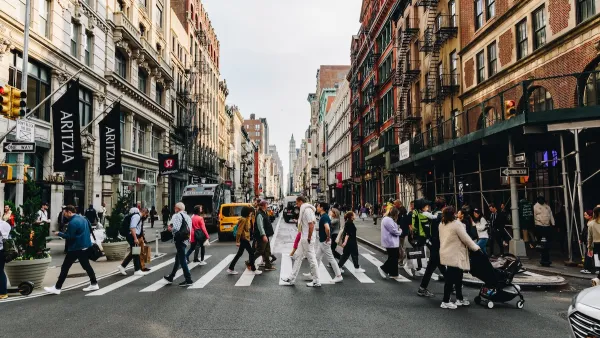
A gas leak in NYC is costing residents $300 million
More than 90% of NYC’s electricity is from natural gas. About 2% of that gas is leaking and escaping into the air.
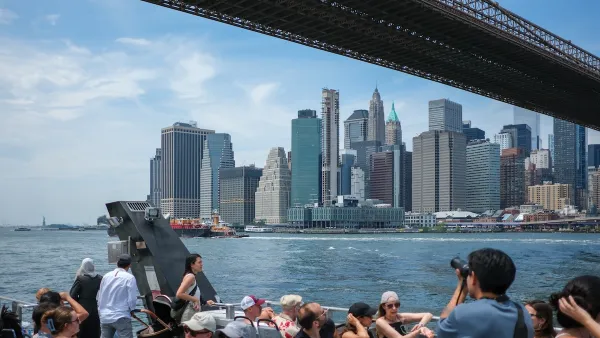
This 55-year-old boat is NYC’s first step towards moving freight deliveries from land to sea
New York City hopes to reduce emissions by creating a 'blue highways' program that embraces boats as a means of transporting freight.

Data reveals that NYC’s bet on congestion pricing has paid off
After almost two years of the program, reports show positive impacts on traffic and air quality and no disruptions to parking.

Planetizen Federal Action Tracker
A weekly monitor of how Trump’s orders and actions are impacting planners and planning in America.
Data reveals that NYC’s bet on congestion pricing has paid off
After almost two years of the program, reports show positive impacts on traffic and air quality and no disruptions to parking.

HUD modernizes 50-year-old manufactured housing framework
The Next Generation Manufactured Housing Action Plan establishes new energy-efficiency standards for manufactured homes, and new guidelines for anchoring them.

California voters weigh $11.25 billion housing bond
Prop. 1, combined with other funding, would support over 40,000 new rental units in California.

Connecticut is turning landfills into green infrastructure
Twenty-nine solar arrays have been built, or approved to be built, on top of Connecticut landfills.

Trump guts ‘win-win’ solar energy program for rural farmers
The U.S. Department of Agriculture’s changes have made virtually all solar power ineligible for funding through the Rural Energy for America Program.

FREE Course: Walkable City 1: Why Walkability?
After describing his path towards focusing on walkability as the essence of good planning, Jeff Speck marches through his five principal reasons for making more walkable places.
Reinventing Malls: Planning Alchemy—Turning Gray Fields Into Gold
The course focuses on the opportunities and imperatives that shape reinvention of mall sites.

One Hundred Miles
County of Mendocino
planning NEXT
The Architects Foundation
University of Cincinnati Online
Montrose County
Northern Illinois Transit Authority (NITA)
The Pocatello Development Authority