Stephen Smith at Market Urbanism looks at the truth behind the cliché, and finds that while Houston does not have Euclidean zoning, it does have more unconventional means of controlling land use beyond the invisible hand of the free market.


Smith quotes a paper by Planetizen blogger Michael Lewyn that says that minimum lot sizes are common in the supposedly unplanned Houston.
"Not to be outdone by minimum lot restrictions, the parking planners are also hard at work in Houston. As Donald Shoup explains in his magnum opus on parking regulations and the free market, minimum parking regulations are an oft-used and under-appreciated way for city planners to decrease density, push development farther from the city's core, increase an area's auto dependency, and decrease walkability and the viability of mass transit. Houston's planning code mandates that developers, regardless of what they perceive as the actual demand, build 1.25 parking spaces per apartment bedroom, and 1.33 spaces per efficiency apartment. Retail stores are also saddled with these parking minimums, and even bars as Lewyn notes are required to build "10 parking spaces per 1000 feet of gross area," flying in the face of common sense. To add insult to injury, the city requires that structures on major roads have a significant setback from the street, and the only rational thing to do with this unbuildable space is to put the mandated parking there, meaning that Houston actual codifies the hideous and inconvenient parking lot-out-front model of sprawl that is so typical across the US."
Read the full story: Urbanism Legend: Is Houston really unplanned?


Study: Minimum lot sizes reinforce racial disparities
A Connecticut study found that zoning rules perpetuate residential segregation.
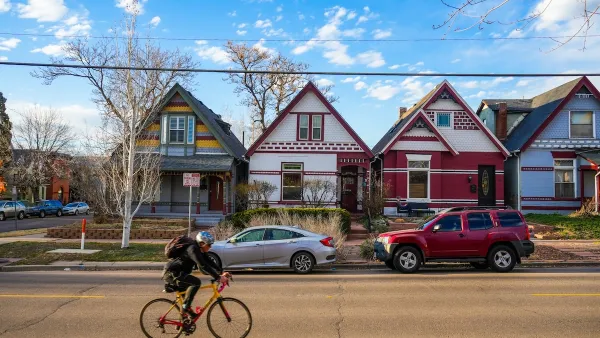
Amidst Colorado Affordability Crisis, Just 3% of Residential Land Zoned for Multifamily Housing
A new report suggests loosening restrictive zoning laws on multifamily development could help bring down high housing costs.

How Houston Can Be a Model for Housing Reform
The city builds more new housing than almost any other and has dramatically reduced homelessness, yet low-income families struggle to find affordable housing.

Planetizen Federal Action Tracker
A weekly monitor of how Trump’s orders and actions are impacting planners and planning in America.

Amtrak, CN end decades-long dispute with eight-year agreement
The new operating agreement establishes an updated framework for the companies to work together, including processes to resolve disputes.

Northwest rail fans eager for Sept. 30 debut of Amtrak’s Airo fleet
Get ready for that new train smell and more seats. But they won’t go faster or run more frequently on the Cascades route in Washington and Oregon.

Brightline Florida files for bankruptcy
The transit company is over $5 billion in debt.

St. Louis Metro to test if single-car trains can reduce operating costs, maintain rider satisfaction
The pilot program will run from October to spring 2027, and begin with one single-car train operating on Metrolink’s Red and Blue lines.

Pennsylvania is building data centers in abandoned mines
Housing data centers in mines provides an alternative to destroying local forests and may spare residents from data centers’ noise and air pollution.

FREE Course: Walkable City 1: Why Walkability?
After describing his path towards focusing on walkability as the essence of good planning, Jeff Speck marches through his five principal reasons for making more walkable places.
Reinventing Malls: Planning Alchemy—Turning Gray Fields Into Gold
The course focuses on the opportunities and imperatives that shape reinvention of mall sites.

City of Thousand Oaks
City of Wisconsin Rapids
Harvard University Graduate School of Design
The Architects Foundation
University of Cincinnati Online
The Pocatello Development Authority
The Urban Renewal Agency of the City of Pocatello