Tough economic times spell troubles for city budgets. One way to cut back on costs is to rethink operation of seemingly untouchable public safety services like police and firefighters, according to this column from Neal Peirce.


"Among America's 87,500 governments, only Washington can print money. In a pinch, the only real option for cities and states is to spend less-thereby taking money out of the economy and deepening recession. With more than 20 million employees, 14 percent of the total American workforce, states and cities are a significant part of the total national economy."
"This recession seems sure to be so serious, say urban finance experts, that many cities will be forced to go well beyond their familiar tight-times reductions in park and library budgets. A growing possibility: to cut into that historically inviolate sector–police officers and firefighters."
"Together, police and fire operations consume the lion's share of most local budgets. And the fire operations represent the most wastefully managed part of local government, according to municipal experts who spoke as a panel at a National Academy of Public Administration meeting said last week."
Read the full story: In An Epic Fiscal Storm, New Strategies Sprout

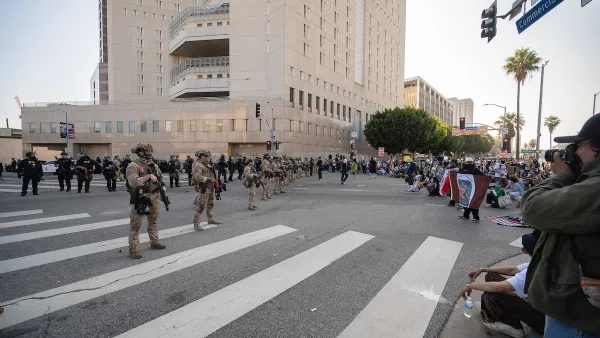
Opinion: Far From Cauldrons of Violence, Cities are Anti-Crime Innovators
Rather than funding the performative militarization of law enforcement, the federal government could instead support programs that prevent poverty and crime before it happens.
States Cut Funds to Cities
State budget problems are trickling down to cities, which are being cut off from funding by their governors.
Revenue-Hungry Cities Look to PILOTs
Budget-constrained cities are increasingly looking at PILOTs -- payments in lieu of taxes that some tax-exempt nonprofit organizations contribute to cities.

Planetizen Federal Action Tracker
A weekly monitor of how Trump’s orders and actions are impacting planners and planning in America.

Northwest rail fans eager for Sept. 30 debut of Amtrak’s Airo fleet
Get ready for that new train smell and more seats. But they won’t go faster or run more frequently on the Cascades route in Washington and Oregon.
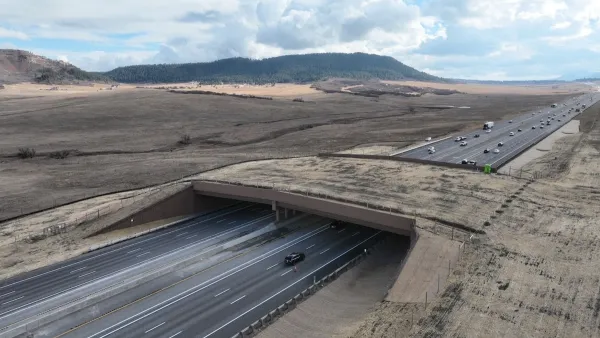
Record-breaking wildlife overpass in Colorado brings 91% reduction in animal collisions
Prior to the overpass, vehicles were hitting one deer per day on Colorado’s Interstate 25.

Detroit to transform waterfront with $2.2 billion investment
Developers will convert about 18 acres of unused parking lot space into civic spaces.

‘Going backwards:’ Baltimore mayor, students rally against state's transit funding plan
Maryland's proposed six-year plan provides no funding for Baltimore’s BMORE bus program and reduces its road maintenance funding.

Trump wants to cancel nearly 98% of funding for HUD housing support program
Multiple housing groups are suing the administration in an effort to preserve the funding.

FREE Course: Walkable City 1: Why Walkability?
After describing his path towards focusing on walkability as the essence of good planning, Jeff Speck marches through his five principal reasons for making more walkable places.
Reinventing Malls: Planning Alchemy—Turning Gray Fields Into Gold
The course focuses on the opportunities and imperatives that shape reinvention of mall sites.

City of Thousand Oaks
City of Wisconsin Rapids
Harvard University Graduate School of Design
The Architects Foundation
University of Cincinnati Online
Northern Illinois Transit Authority (NITA)
The Pocatello Development Authority
The Urban Renewal Agency of the City of Pocatello