Jane Jacobs once said, “Songs and cities are the best things about us. Songs and cities are so indispensable.” For a long time I thought Mother Jacobs was speaking, as only she could, about two separate, but vital human necessities. Yet after another weekend exploring New York City, I am convinced the two—songs and cities—are inextricably linked. That is, truly great cities play their own songs, and after one listen you can’t get them out of your head.


Jane Jacobs once said, "Songs and cities are the best things
about us. Songs and cities are so indispensable."
For a long time I thought Mother Jacobs was speaking, as
only she could, about two separate, but vital human necessities. Yet after
another weekend exploring New York
City, I am convinced the two-songs and cities-are
inextricably linked. That is, truly great cities play their own songs, and
after one listen you can't get them out of your head.
On a Saturday fall afternoon New York
City's Columbus
Park plays an
intoxicating tune, but broadcasts it no farther than the neighborhood in which
it originates. Located at the southern tip of Manhattan's
Chinatown neighborhood, the park effectively
functions as a release valve for what may be the city's most frenetic
neighborhood. Indeed, while Chinatown screams with a constant rhythm of
commercial transaction, Columbus
Park hums with a diverse
array of leisure activity. As such, the park provides the neighborhood a needed
change of key.

Typical Chinatown street scene.
However, this was not always the case. After years of
neglect, a 2005 redesign repositioned the park by clearly improving a triad of
public space that includes athletic playing fields, an intimate tree-filled
square, and a restored multi-use pavilion. In sum, this progression of open
space types-active, passive, and monumental-creates a diverse ensemble of site,
sound and use. It is a truly great, polyphonic urban space.
With this in mind, it's no surprise that Columbus Park is now
the de facto meeting place for a
mostly Chinese population that has different cultural needs and expectations
than, say, the residents of a tony suburb in Long Island or New Jersey. In
fact, in the seminal text, The Great Good
Place, author Ray Oldenburg states the most successful third places in
America are those located in " ethnic
enclaves where generational ties are maintained against that powerful
dissolving agent known as the American way of life." As it relates to Columbus Park, such an observation could not be
more accurate.
Upon entering the square from the northeast corner, at the
intersection of Mulberry and Bayard
Street, you may find a small group of gregarious
men playing an interesting selection of songs and instruments from their motherland. They call themselves the Columbus Park Senior
Orchestra and although their gift to the neighborhood is not amplified, they
truly energize this corner of the park.

The Chinatown Senior Orchestra prepares to play another song.
The orchestra's small side stage soon gives way to a main stage
located in the central part of the square. Here the steady cadence of Mandarin
(could be some Cantonese, too) is intoned by all and
men and women separate themselves into factions of activity. For the most part,
both groups socialize spiritedly through various board and card games.
Nonetheless, the inflections of their voices make clear that both groups are
keenly aware of the other. The stage, after all, is a place to see and be
seen.

The men of Chinatown.

The women of Chinatown. (Courtesy of Leslie Pariseau)
Behind the stage the open air pavilion provides a wonderful
backdrop. From its steps one may watch the stage from a new perspective. From
this vantage point the onlooker may note the presence of an audience who keenly
listens and observes those who chose to sing on stage. The audience is mostly comprised of people
enjoying a quiet respite from the din of neighborhood streets, or casual
interlopers taking stock of a well-rehearsed concert that never features the
same set list.

From the pavilion, groups of men and their audience can be seen.
Inside the pavilion, men serenade women with invitations to
dance, and music is transmitted over a small floor radio. It is more quiet
here, but rightly so, as the pavilion seems reserved for reflection and
romance. Such elements would serve as a muse to many a musician.

The pavilion offers ceremonial space and a nice backdrop for the stage.
Perhaps what is most appealing about this portion of Columbus Park is its size. It is large enough so
that the normal cacophony of city noise dissipates into the roiling banter,
music and charm of Chinatown's most loved
public space. But it is also small enough so that the symphonic sounds of the
square remain intact. It is the perfect venue.

Three men enjoy each other's company and the sites and sounds of the square. (Courtesy of Leslie Pariseau)
South of the square a more diverse clientele- soccer
players, fall sky gazing lovers and the homeless-occupy and activate the
balance of open space. This section is clearly the largest, but little, if any
Mandarin is spoken there. Rather, the athletic fields function as a transition
zone to Manhattan's
competitive financial district where it seems the only songs being played these
days are the blues.

Columbus Park Athletic Fields.

The Huddle. (Courtesy of Leslie Pariseau)
Nonetheless, the fields are well used and the mixture of
activity provides yet another layer of instrumentation to what Jane Jacobs
would call an indispensable, if not irresistible city song.

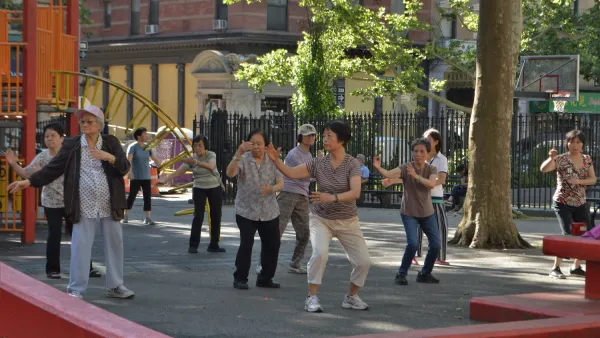
How a NYC Teen is Helping Chinese Seniors Navigate the Affordable Housing System
For low-income seniors with limited English and tech proficiency, navigating New York City's affordable housing systems is a challenge. To help, we must think beyond affordability.
Mahjong Game Highlights Displacement of Seniors in NYC’s Chinatown
‘Aging Out of Place’ explores the mechanisms that displace vulnerable seniors, and how the community can help preserve key resources and institutions.

A Visual Celebration of Manhattan’s Chinatown Elder Community, Through Food
Lanterns, cafeteria trays, and community connection take center stage in this stunning photo essay.

Planetizen Federal Action Tracker
A weekly monitor of how Trump’s orders and actions are impacting planners and planning in America.

‘Going backwards:’ Baltimore mayor, students rally against state's transit funding plan
Maryland's proposed six-year plan provides no funding for Baltimore’s BMORE bus program and reduces its road maintenance funding.

Detroit to transform waterfront with $2.2 billion investment
Developers will convert about 18 acres of unused parking lot space into civic spaces.

HUD modernizes 50-year-old manufactured housing framework
The Next Generation Manufactured Housing Action Plan establishes new energy-efficiency standards for manufactured homes, and new guidelines for anchoring them.

New CA housing laws tear down development red tape
Recently-signed legislation makes building starter homes and ADUs cheaper and faster in California.

Metrolink finishes first expansion in 20 years
The transit agency is now one of very few in the United States to connect two major airports.

FREE Course: Walkable City 1: Why Walkability?
After describing his path towards focusing on walkability as the essence of good planning, Jeff Speck marches through his five principal reasons for making more walkable places.
Reinventing Malls: Planning Alchemy—Turning Gray Fields Into Gold
The course focuses on the opportunities and imperatives that shape reinvention of mall sites.

County of Mendocino
planning NEXT
City of Thousand Oaks
The Architects Foundation
University of Cincinnati Online
Montrose County
Northern Illinois Transit Authority (NITA)
The Pocatello Development Authority

