Over the past few years, San Francisco's waterfront has become home to art pieces like an enormous, cartoony bow and arrow and a giant spider. Labor historians have a different idea: A five-story crane built in the early 1970s for loading coconuts.


"Labor historian and folklorist Archie Green just scratches his head and chuckles when it comes to artwork along San Francisco's waterfront, including what he called 'a modern stainless steel skyscraper or some god-damned thing' and 'a gal in a bikini and a little child.'
Green is 91 and sports a stocking cap and a Burgess Meredith glint in his eye. He can warm up a room of government officials like nobody's business. So when the retired shipwright and his pals wanted to get a defunct shipping crane refurbished as a blue-collar addition in the public art and installation column, officials started to listen.
'All of the work on the waterfront is so abstract and so artistic and so representative of high culture,' Green told the Port Commission at its Tuesday meeting in the polished Ferry Building. 'There's nothing on the waterfront today that signifies those of us who built this building, who built this waterfront.'"
Read the full story: How's this for art?
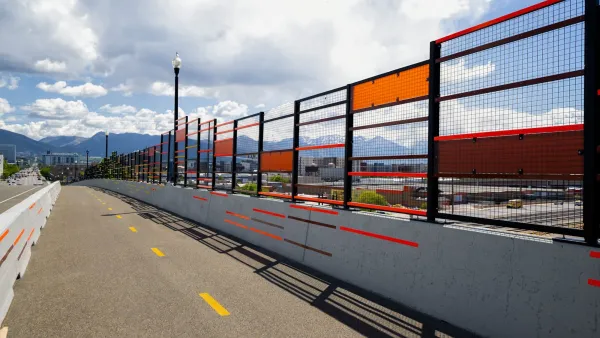
Salt Lake City opens protected bike path on viaduct trail
The 400 South Viaduct Trail features the state's longest continuous piece of public art.
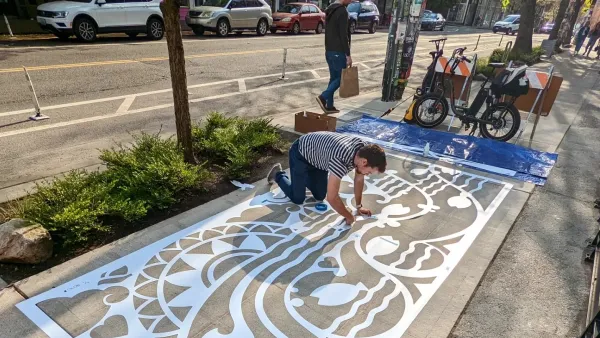
This Seattle sidewalk art only appears when it rains
Prompted to find a silver lining to the gloom of rainy Pacific Northwest days, an artist hit upon a novel solution: water-activated sidewalk paint.
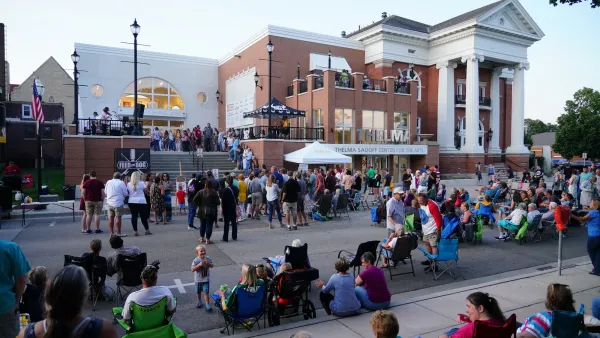
How Placemaking Lost its Way — And How it Can Get Back on Track
The term has often become diluted, getting attached to projects that don’t live up to its lofty aspirations.

Desperate measures: Advocates weigh draining Lake Powell to fill Colorado River
Draining the reservoir could reduce evaporation losses by a couple hundred thousand acre-feet.

Eastern Nebraska is running out of electricity
Data centers and electrification are straining eastern Nebraska’s grid, throttling economic development.

Malls are becoming the midtowns of the future
Mall and office park redevelopments are a generational opportunity to create new nodes of urbanity.

NYC breaks ground on anti-flooding infrastructure project
New York City's new system will reduce stormwater flows to local sewers by 90%.

One Kentucky town’s secret to affordable housing
The Smoketown Community Land Trust has already built seven affordable homes for community members.

Houston gains petal-shaped cooling infrastructure to make streets more ‘delightful’
The city has installed the pavilions along 15 blocks in Houston.

FREE Course: Walkable City 1: Why Walkability?
After describing his path towards focusing on walkability as the essence of good planning, Jeff Speck marches through his five principal reasons for making more walkable places.
Reinventing Malls: Planning Alchemy—Turning Gray Fields Into Gold
The course focuses on the opportunities and imperatives that shape reinvention of mall sites.

City of Rosemead
Rutgers University, Edward J. Bloustein School of Planning and Public Policy
One Hundred Miles
University of Michigan School for Environment and Sustainability (SEAS)
Hunter College, City University of New York (CUNY)
The Architects Foundation
City of Cambridge
Montrose County
The Pocatello Development Authority