This commentary from ArchNewsNow wonders whether urbanism is really the cause of social alienation, not the cure.


"The statistical revelation behind all of these findings is that for every 10% increase in density, there is a 10% decrease in socialization. That's a simple, one-to-one inverse relationship that everyone can understand."
"Of course this scientifically researched revelation begs the question, 'Why is this so?' The authors of the study suggest that "crowding associated with a dense environment might spur a need for privacy, causing people to draw inward. Such behavior could reflect the old saying: ‘good fences make good neighbors.'' The authors' conclusion is that 'density has been shown to exert a negative influence on social interaction, undermining an important line of attack used by critics of urban sprawl.' This may be an inconvenient truth for the New Urbanist movement, but this negative view of density is hardly new."
Read the full story: Bowling Alone in Urbanistaville

August Must-Reads: Top 10 Articles From Last Month
In suburban Houston, cities are scrambling to expand water infrastructure to serve new communities. But can sprawl be part of a workable solution to the housing crisis?

Why Is Silicon Valley So Bleak?
The built environment in one of the most affluent places in the country leaves much to be desired. Why are Silicon Valley communities missing so many key urban features?
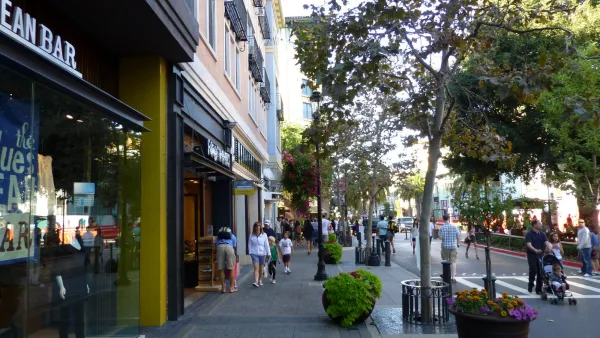
Can Urbanist Islands Make a Difference Where Sprawl Reigns?
The product of a single developer, San Jose's Santana Row is a pocket of urbanism in a sea of sprawl. But can it influence development patterns beyond its bounds, and should it?

Planetizen Federal Action Tracker
A weekly monitor of how Trump’s orders and actions are impacting planners and planning in America.

Amtrak, CN end decades-long dispute with eight-year agreement
The new operating agreement establishes an updated framework for the companies to work together, including processes to resolve disputes.

Northwest rail fans eager for Sept. 30 debut of Amtrak’s Airo fleet
Get ready for that new train smell and more seats. But they won’t go faster or run more frequently on the Cascades route in Washington and Oregon.

Trump administration unlawfully slashed $7 billion in clean energy grants, judge rules
The Environmental Protection Agency ended the Solar For All program, which provided the grants, after President Donald Trump’s inauguration.

Record-breaking wildlife overpass in Colorado brings 91% reduction in animal collisions
Prior to the overpass, vehicles were hitting one deer per day on Colorado’s Interstate 25.

California lawmakers approve just 5% of much-needed LA28 transportation funding
State legislators appear just as unwilling as Trump to pay for Olympics-related transportation projects.

FREE Course: Walkable City 1: Why Walkability?
After describing his path towards focusing on walkability as the essence of good planning, Jeff Speck marches through his five principal reasons for making more walkable places.
Reinventing Malls: Planning Alchemy—Turning Gray Fields Into Gold
The course focuses on the opportunities and imperatives that shape reinvention of mall sites.

City of Thousand Oaks
City of Wisconsin Rapids
Harvard University Graduate School of Design
The Architects Foundation
University of Cincinnati Online
The Pocatello Development Authority
The Urban Renewal Agency of the City of Pocatello