Today, I turned in my grades for my seminar on "Sprawl and the Law." It occurred to me that some readers of this blog might be academics, and might be interested on how one can teach a course on sprawl. I began by defining the issue. As I pointed out in an earlier post (at http://www.planetizen.com/node/31063) the term "sprawl" has two common meanings: where we grow (city or suburb) and how we grow (pedestrian-friendly or automobile-dependent). Policies that affect the first type of "sprawl" need not affect the second (and vice versa).



Today, I turned in my grades for my seminar on "Sprawl and the Law." It occurred to me that some readers of this blog might be academics, and might be interested on how one can teach a course on sprawl.
I began by defining the issue. As I pointed out in an earlier post (at http://www.planetizen.com/node/31063) the term "sprawl" has two common meanings: where we grow (city or suburb) and how we grow (pedestrian-friendly or automobile-dependent). Policies that affect the first type of "sprawl" need not affect the second (and vice versa).
Then we discussed the question frequently debated on Planetizen: is sprawl good or bad? I used Oliver Gillham's book, The Limitless City, as a text, since Gillham addresses both sides of the argument. We discussed sprawl's impact on social equity, air pollution, traffic congestion, and a variety of other matters. Because my courses focus on legal issues, I limited our discussion of the pros and cons of sprawl to one class. However, urban planning instructors might wish to devote more time to the question.
But because I teach in a law school, I focused on legal rules relevant to sprawl. I began by focusing on the "how we grow" element of sprawl; since Jacksonville (where I live and teach) is a growing but highly car-dominated city, I believed that this element of sprawl was more relevant to my students than the urban decay common in Rust Belt cities. In particular, I spent most of the course on land use and street design regulations that contribute to sprawl: we read case law on zoning laws segregating land uses, minimum lot size requirements, and minimum parking and setback regulations, as well as examples of, and critiques of, those rules. Similarly, we read and discussed pro-sprawl street design regulations, such as rules mandating wide streets and cul-de-sacs. We then discussed possible solutions to pro-sprawl land use regulation, such as land use deregulation and New Urbanism. And because many of my students had never known anything but sprawl, we made field trips to Jacksonville's most pedestrian-friendly neighborhoods.
The last few weeks of the course were spent on the "where we grow" element of sprawl. We focused on highways and public transit, as well as the pros and cons of land use policies designed to curb suburban development and/or encourage urban redevelopment, such as Oregon's urban growth boundaries and the sort of redevelopment-oriented eminent domain upheld by the Supreme Court in Kelo v. New London. In addition, we spent about an hour or so of class time on the poor quality of urban schools as a driver of suburban migration, and on solutions to this problem (such as vouchers and school finance reform). If I was teaching in a declining city (such as St. Louis) I would have spent more time on "where we grow" sprawl, and in particular on the education issue.

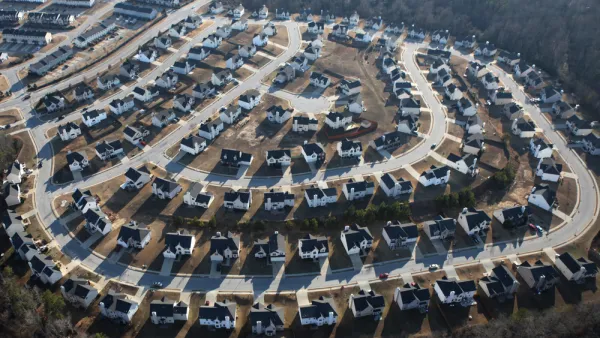
How to Teach About Sprawl (and Law)
Describing a seminar on "Sprawl and the Law" at the University of Pittsburgh.
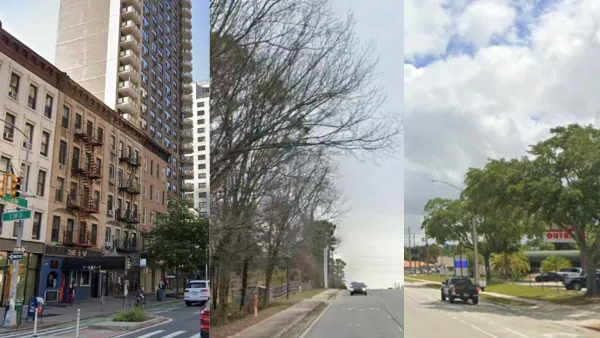
A Transect of sprawl
A development pattern this lifestyle-defining deserves its whole own classification system.

What the fall of earth's largest pre-industrial city can teach us about urban sprawl
Angkor was a low-density metropolis. It lasted six centuries, until it could no longer maintain its infrastructure in a changing climate. Today, it offers planners a sobering warning about the risks of dispersed urban living.

Planetizen Federal Action Tracker
A weekly monitor of how Trump’s orders and actions are impacting planners and planning in America.

‘Going backwards:’ Baltimore mayor, students rally against state's transit funding plan
Maryland's proposed six-year plan provides no funding for Baltimore’s BMORE bus program and reduces its road maintenance funding.

Detroit to transform waterfront with $2.2 billion investment
Developers will convert about 18 acres of unused parking lot space into civic spaces.

Newsom vetoes high-speed rail supervision bill after agency receives condemnatory audit
The audit found the CHSRA approved almost $600,000 in unallowable travel expenses.

Nation sees first electric plane-boat hybrid take off in public demo
The Viceroy Seaglider can fly at speeds of 180mph for up to 180 miles.

One of nation’s poorest counties to receive $6 billion data center
The developers estimate the project will create 200 permanent jobs and 1,000 temporary construction jobs.

FREE Course: Walkable City 1: Why Walkability?
After describing his path towards focusing on walkability as the essence of good planning, Jeff Speck marches through his five principal reasons for making more walkable places.
Reinventing Malls: Planning Alchemy—Turning Gray Fields Into Gold
The course focuses on the opportunities and imperatives that shape reinvention of mall sites.

City of Thousand Oaks
City of Wisconsin Rapids
Harvard University Graduate School of Design
The Architects Foundation
University of Cincinnati Online
Northern Illinois Transit Authority (NITA)
The Pocatello Development Authority
The Urban Renewal Agency of the City of Pocatello

