As Mayor Bloomberg moves forward with an eco-friendly redevelopment for the crumbling Willets Point neighborhood, locals feel pushed aside and complain that eminent domain is out of control.


The pavement surrounding J and L Auto, at the corner of 36th Ave. and Willets Point Blvd., is split open into dozens of fist-sized fractures, exposing the remains of the worn cobblestone underneath. It is a reminder of the storied history of this neighborhood, which sits west of the Flushing River, under the shadow of Citi Field, the future stadium of the New York Mets. It's also a testament to decades of systemic neglect, both from the city and the mechanics and auto body specialists who work here.
"Hollowed-out wrecks line Willets Point, and industrial runoff spills freely into large, muddy puddles. There are no sidewalks in the 'Calcutta of New York,' as it is locally known. There is no sewer system. Shops are packed shoulder to shoulder along the streets, topped by corrugated metal, emblazoned with bright yellow and red signs, and filled with employees who wander out occasionally into the sunlight to offer 'the very lowest price.'
'People forget – Willets Point isn't a town,' says Andrew Wiedhopf, a longtime employee of J and L Auto. 'It isn't a city. It's just one, enormous, ugly junkyard.'
It's also, Mr. Wiedhopf concedes, a battleground, although – like most mechanics operating in the area – he estimates that the fight will soon be over. Earlier this year, Mayor Michael Bloomberg announced plans to level the area's garages and repair shops, paving the way for New York City's first 'green neighborhood.' The designation is based on a few key initiatives: the widespread use of green building technologies to minimize energy use; a wealth of parks, playgrounds, and walkways, which would drive up pedestrian traffic; and the incorporation of "sustainability principles" into design, construction, and cleanup."
Read the full story: Going ‘green’ has Willets Point seeing red
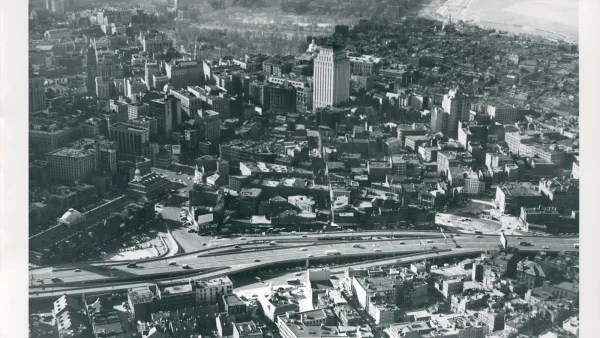
Watch: The Dark Side of Eminent Domain
In cities like Boston, the government’s right to take private property displaced residents and destroyed vulnerable neighborhoods and communities.
New Twist on Eminent Domain
Boston uses the threat of eminent domain to force a developer to build on a site that's become an eyesore.
Is eminent domain necessary for revitalizing cities?
Planners are split on eminent domain—one group believes it’s a critical component of planning since it allows them to implement plans more quickly. Others believe eminent domain does more to destroy urbanism than build it up. I’ve weighed in on it numerous times, including this commentary published by Planetizen.

Planetizen Federal Action Tracker
A weekly monitor of how Trump’s orders and actions are impacting planners and planning in America.

Eastern Nebraska is running out of electricity
Data centers and electrification are straining eastern Nebraska’s grid, throttling economic development.

Move over, LA: St. Louis gears up for Olympics, invests millions in downtown redevelopment
The Missouri city will host the 2028 Olympic soccer group stage and knockout matches.

Dallas releases zoning code overhaul to officials
The drafted overhaul is over 400 pages long.

NYC renovations for dangerous, ‘mercilessly crammed’ street delayed until 2027
Construction was supposed to begin this fall.

San Diego’s Midway Rising project gets greenlight from city council
The project looks to become the largest affordable housing development in California's history.

FREE Course: Walkable City 1: Why Walkability?
After describing his path towards focusing on walkability as the essence of good planning, Jeff Speck marches through his five principal reasons for making more walkable places.
Reinventing Malls: Planning Alchemy—Turning Gray Fields Into Gold
The course focuses on the opportunities and imperatives that shape reinvention of mall sites.

City of Rosemead
Rutgers University, Edward J. Bloustein School of Planning and Public Policy
One Hundred Miles
University of Michigan School for Environment and Sustainability (SEAS)
Hunter College, City University of New York (CUNY)
The Architects Foundation
City of Cambridge
The Pocatello Development Authority
The Urban Renewal Agency of the City of Pocatello