As a part of Chicago's $1.4 billion "Plan for Transformation," the once massive Cabrini-Green project has been redeveloped into a mix of affordable, public and market housing. But 80% of the former tenants have moved away.


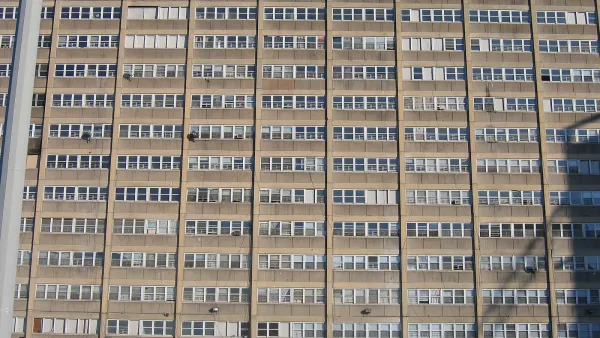
"Cabrini-Green is Chicago's best-known housing project, and was the first to see the wrecking ball. At its height, Cabrini was home to 15,000 residents spread over 15 red-brick high-rises (the "Reds"), eight 16-story towers (the "Whites"), and a patch of street-level row houses. The row houses, built in 1942, were originally home to Italian immigrants; 15 years later, the high-rises began to go up to accommodate the growing number of Southern blacks moving to Chicago. Before long, Cabrini-Green became a segregated black ghetto with a reputation for crime, poverty, and urban decay.
By 2000, the Chicago Housing Authority was entrusted with a $1.4 billion budget to overhaul its public housing, with much of the initial funding coming from the Department of Housing and Urban Development. Finally, after decades of neglect and agency corruption, the CHA-which had been taken over for a time by HUD-would begin dismantling its public housing system in a strategy called the Plan for Transformation or, more simply, the Plan.
The Plan was originally scheduled for completion next year, but the deadline has been extended to 2015, due in part to tenant litigation and the drying up of federal funds. When it's done, 25,000 public-housing units will have been razed or rehabilitated across the city. The impact of the Plan on the city's landscape is already unmistakable. Cabrini-Green, once a massive cluster of high-rises and row houses just a 10-minute walk from the elegant stores of Michigan Avenue, is mostly gone. A handful of buildings remain, surrounded on all sides by new condominiums and booming retail stores. Twenty percent of these condos have been set aside as affordable housing; a third will be public housing. The rest are selling for up to $850,000 a piece. Since the Plan launched, in 2000, more than $2 billion in residential property has been sold within two blocks of Cabrini.
When the Plan came to Cabrini, all lease-abiding residents were given a legal "right to return" to a new apartment on-site, but those who didn't want to wait years for a new home, or who feared they wouldn't qualify, could take a rent subsidy voucher, called a Section 8, and live elsewhere. More than 80 percent of the tenants who opted for this voucher have moved to areas of Chicago more segregated, isolated, and poor than Cabrini had been.
Miami announced recently that it will pursue a similar strategy, joining other American cities already following Chicago's lead. What this will mean for the country's urban poor is not yet known-whether plans like this will deliver their promise of safe, improved shelter, or merely serve as city-sponsored gentrification schemes, reducing the amount of safe housing available to the country's neediest people. Public-housing advocates express concern about the implementation of such a national-scale strategy before the real human costs can be measured."
Read the full story: Two Tales of One City

Candyman's Real Horror: American Public Housing Policy
The new film, set in one of America's most notorious public housing projects, highlights the failure of affordable housing policy and its impact on Black communities.

Large Mixed-Use Development the Latest Step in Cabrini-Green's Complete Redevelopment
The process of redeveloping the site of one of the country's most infamous public housing complexes, Cabrini-Green in Chicago, will soon take another substantial step into the future.

Embracing Rivers as a Vehicle for Urban Revitalization
A new study includes urban rivers as a potential powerful amenity for economic development and revitalization. The city of Chicago has already taken note.

Planetizen Federal Action Tracker
A weekly monitor of how Trump’s orders and actions are impacting planners and planning in America.

HUD modernizes 50-year-old manufactured housing framework
The Next Generation Manufactured Housing Action Plan establishes new energy-efficiency standards for manufactured homes, and new guidelines for anchoring them.

Data reveals that NYC’s bet on congestion pricing has paid off
After almost two years of the program, reports show positive impacts on traffic and air quality and no disruptions to parking.

Developers sue Mississippi landowners who object to pipeline through their land
Because the Federal Energy Regulatory Commission approved the pipeline project, the developer can use private land without the consent of the owner.

A gas leak in NYC is costing residents $300 million
More than 90% of NYC’s electricity is from natural gas. About 2% of that gas is leaking and escaping into the air.

CA officials have the power to fix the state’s riskiest dams. They’ve never used it
California’s 40 most hazardous dams would endanger up to 1.5 million people if they failed.

FREE Course: Walkable City 1: Why Walkability?
After describing his path towards focusing on walkability as the essence of good planning, Jeff Speck marches through his five principal reasons for making more walkable places.
Reinventing Malls: Planning Alchemy—Turning Gray Fields Into Gold
The course focuses on the opportunities and imperatives that shape reinvention of mall sites.

One Hundred Miles
County of Mendocino
planning NEXT
The Architects Foundation
University of Cincinnati Online
Montrose County
Northern Illinois Transit Authority (NITA)
The Pocatello Development Authority