Every city has blight – the unsightly, derelict, abandoned, disheveled, and under-utilized spaces of our urban areas. It drains the life out of neighborhoods, drives down the values of surrounding properties, and just looks really bad. So what do cities do about it? Some seize it through eminent domain for redevelopment and others offer incentives to developers to replace it with something better. Many of them, though, don’t do anything at all. But removing blight from a city is not impossible, and it doesn’t have to be an elaborate multi-party scheme or a drawn-out political process. It can be as simple as a coat of paint.


Every city has blight – the unsightly, derelict, abandoned, disheveled, and under-utilized spaces of our urban areas. It drains the life out of neighborhoods, drives down the values of surrounding properties, and just looks really bad. So what do cities do about it? Some seize it through eminent domain for redevelopment and others offer incentives to developers to replace it with something better. Many of them, though, don't do anything at all. But removing blight from a city is not impossible, and it doesn't have to be an elaborate multi-party scheme or a drawn-out political process. It can be as simple as a coat of paint.
In most cases blighted properties are left to rot on their own, below the eyesight of city officials and politicians. But blight out of sight is still blight in the end, and it is a situation that not only feeds on itself, but feeds on its surroundings. Stopping the blight monster from swallowing up entire neighborhoods does require effort, but maybe not as much as some would think.
The borough of Delfshaven in Rotterdam had the very simple idea that if blighted areas were more noticeable they would be more likely to attract the attention of neighbors and the movers and shakers capable of taking the action to remedy them. So they contacted local artist Florentijn Hofman to come up with an idea to make a one blighted and derelict block of the borough more noticeable. Hofman's solution was a new coat of paint – bright sky blue, over the entire building; windows, roofs and all.
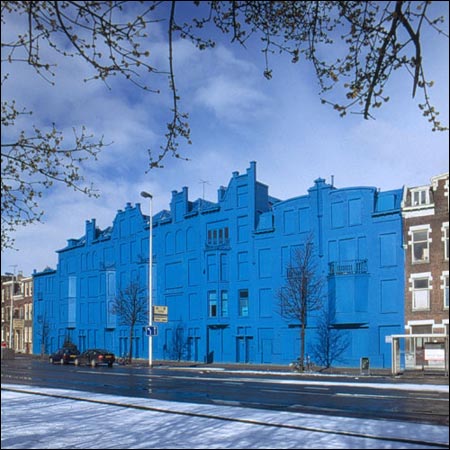
The idea was to keep the building in its bright blue state until there was a viable plan to renew or revive the blighted area. And almost instantly, what was once an overlooked and easily ignorable area became one of the most seen places in the city. As Hofman's website describes, "By redecorating this block, which was built in the first years of the 20th century, people start looking again at what was and is there, and maybe think about what they will get in return."
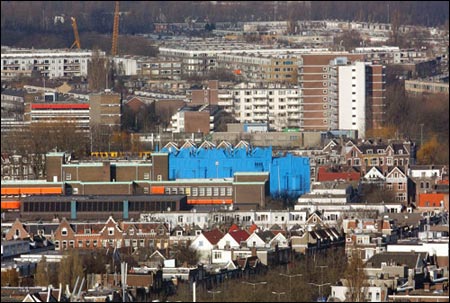
This blue building not only brings people's attention back to a once-forgotten space, but also works to prod the development (or redevelopment) community to take advantage of the existing opportunities in the city. Having a bright blue building screaming at your face every day – whether you're a developer, a planner or a neighbor – would most likely motivate you to see about getting something done.
Other cities should learn from this example, and should start to rethink how they handle (or don't handle) their blighted areas. By creating a situation that is at once a call to action, an unavoidable reminder, and even a tourist attraction, cities can better realize the potential of the blighted spaces they might have otherwise continued to disregard.
UPDATE: Florentijn Hofman recently contacted me to add a little more clarity to this blog post. From Hofman:
"The borough of Delfshaven in Rotterdam asked me to do a wall they wanted to put there to cover the doors of the derelict block. They had the notion of graffiti, and asked me to make a mural with a local graffiti artist. I said 'No!' and came up with this idea. The moral of the story is they wanted to make the area more nice but with an ancient method (graffiti) -- as if that always works. It's a tool they knew. I've given them another tool -- paint the whole block! Now I see it done more and more often in other boroughs of the city."

This university-owned city block in Chicago has languished for over a decade. Neighbors say it's time to let go
The university never built its planned student housing, letting a row of storefronts sit vacant for years.
Philadelphia sees 29% drop in gun violence near new green spaces
A city-backed program that cleans up blighted and vacant lots is creating new public spaces and reducing crime in surrounding communities.
Spokane Could Tax Parking Lots 12% to Increase Development
A proposal before the city council would tax surface parking lots in an effort to boost infill development.

Amtrak, CN end decades-long dispute with eight-year agreement
The new operating agreement establishes an updated framework for the companies to work together, including processes to resolve disputes.

Northwest rail fans eager for Sept. 30 debut of Amtrak’s Airo fleet
Get ready for that new train smell and more seats. But they won’t go faster or run more frequently on the Cascades route in Washington and Oregon.

Judges permit Denver to divert 77,000 acre feet from the Colorado River for reservoir expansion
Overuse and climate change have caused the Colorado River’s water levels to plummet.

NYC to turn city-owned property into thousands of homes
The city has scheduled a public hearing regarding the development for October.

Buses travel at 5mph along this route in NYC. The Bronx's first-ever busway looks to change that
Prior to the busway, buses on the Bx36 route traveled as slowly as 5 miles per hour.

Pittsburg launches 'EZ permits,' aims for one-day turnaround for low-risk permits
The pilot ‘fast lane’ for permits is part of a bundle of modernization efforts for Pittsburg’s permitting process.

FREE Course: Walkable City 1: Why Walkability?
After describing his path towards focusing on walkability as the essence of good planning, Jeff Speck marches through his five principal reasons for making more walkable places.
Reinventing Malls: Planning Alchemy—Turning Gray Fields Into Gold
The course focuses on the opportunities and imperatives that shape reinvention of mall sites.

City of Thousand Oaks
City of Wisconsin Rapids
Harvard University Graduate School of Design
The Architects Foundation
University of Cincinnati Online
The Pocatello Development Authority
The Urban Renewal Agency of the City of Pocatello

