After spending more than two decades in local government before my eight years as Governor of Maryland, I came to realize how the state was contributing to the spread of sprawl by funding infrastructure improvements, school construction, and transportation investments, among many other things. When we began to utilize the entire state budget as a tool for smarter growth, we found ourselves in uncharted territory. Leading the way is certainly an adventure, but it also comes with the unenviable task of not having someone who has gone before to help navigate the journey.


After spending more than two decades in local government before my eight years as Governor of Maryland, I came to realize how the state was contributing to the spread of sprawl by funding infrastructure improvements, school construction, and transportation investments, among many other things. When we began to utilize the entire state budget as a tool for smarter growth, we found ourselves in uncharted territory. Leading the way is certainly an adventure, but it also comes with the unenviable task of not having someone who has gone before to help navigate the journey.
After leaving government at the end of my second term, I joined with former New Jersey Governor Christine Todd Whitman in 2005 to start the Governors' Institute on Community Design. The Institute, made possible by funding from the US EPA and the National Endowment for the Arts, exists to help equip governors with the training, knowledge and technical advice they need to realize a fruitful vision of growth for their state.
Generally, after the Governor and his or her staff set an agenda, the Institute will convene a workshop and bring in nationally renowned experts and practitioners in design, planning, transportation, housing, schools, land-use, and the environment to help the Governor and his or her administration get from Point A to their desired Point B. A few weeks ago, we had the opportunity to travel to Dover, Delaware to spend two days with Governor Ruth Ann Minner and her staff for the fourth state Institute. Since 2001, Governor Minner has been forging a path of her own for the First State through Livable Delaware, an agenda "designed to slow sprawl, guide growth to appropriate areas, preserve open space and promote high-quality redevelopment." She has made Livable Delaware a success over the last six years. We were pleased to be able to sit down with her staff and cabinet to provide advice on developing Livable Delaware into an even stronger agenda that will continue long after she leaves office.
The feedback we received from Governor Minner's administration following the workshop-as well as in a press release from her office-let us know that our time and effort will help them reach their goals: "After seven years of hard work, this workshop was a great reminder that we have very powerful laws and tools already at hand, but our guests also made a series of valuable and actionable recommendations to improve our efforts now and beyond this administration."
During the workshop, Ed McMahon of the Urban Land Institute-one of the Institute panelists for the event-asked the kind of question that Governors from Maine to California are asking themselves in regard to their own states: "Do you want the character of Delaware to shape new development, or do you want new development to shape the character of Delaware?"
As Governors across the country seek the answer to this question, more of them are embracing an active, aggressive state role in addressing growth. Governors can tackle so many important issues today-traffic, global warming, economic competitiveness, health, housing affordability, mobility-by setting a state framework for smarter growth.
Notwithstanding that most of my elected career was spent at the local level, I hope this trend continues.

A Transit-Oriented Regional Growth Plan
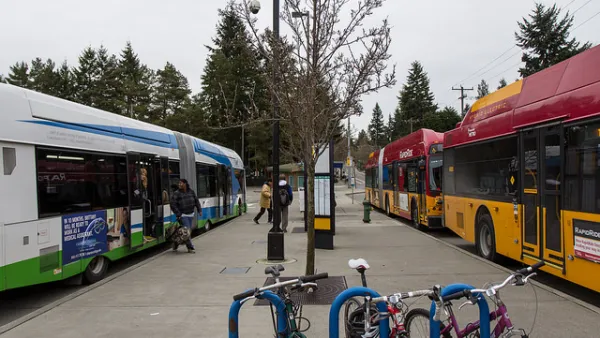
The Vision 2050 plan, which charts the growth for King, Pierce, Snohomish, and Kitsap counties in Washington State, would focus almost all the growth meant to accommodate 1.8 million new residents inside urban areas.

All We Want for the Holidays is…
Here are a dozen timely gift ideas for creating better communities.

Seattle Ponders a New Approach to Zoning for its Comprehensive Plan Update
The city of Seattle will have an updated comprehensive plan by the end of 2024, with zoning changes to follow by 2025.

Planetizen Federal Action Tracker
A weekly monitor of how Trump’s orders and actions are impacting planners and planning in America.

Amtrak, CN end decades-long dispute with eight-year agreement
The new operating agreement establishes an updated framework for the companies to work together, including processes to resolve disputes.

Judges permit Denver to divert 77,000 acre feet from the Colorado River for reservoir expansion
Overuse and climate change have caused the Colorado River’s water levels to plummet.

Atlanta City Council unanimously backs $3.5 billion Beltline light rail project
The resolution was drafted after Atlanta Mayor Andre Dickens pulled support for the Atlanta Streetcar extension last year.

SEPTA to bring nearby frequent transit to over 1 million new riders as part of decade-long plan
The agency's Accelerate plan will also bring frequent transit to twice the amount of jobs that are currently located near it.

NYC plants over 18,000 trees, the most new foliage in a decade
Many of the trees were planted in communities vulnerable to extreme heat.

FREE Course: Walkable City 1: Why Walkability?
After describing his path towards focusing on walkability as the essence of good planning, Jeff Speck marches through his five principal reasons for making more walkable places.
Reinventing Malls: Planning Alchemy—Turning Gray Fields Into Gold
The course focuses on the opportunities and imperatives that shape reinvention of mall sites.

City of Thousand Oaks
City of Wisconsin Rapids
Harvard University Graduate School of Design
The Architects Foundation
University of Cincinnati Online
The Pocatello Development Authority
The Urban Renewal Agency of the City of Pocatello

