Science News reviews the research and opinions linking sprawl and obesity, and investigates whether urban sprawl "makes people fat."


"As scientists investigate the relationship between sprawl and obesity, a compact style of city development sometimes called smart growth might become a tool in the fight for the nation's health. However, University of Toronto economist Matthew Turner charges that "a lot of people out there don't like urban sprawl, and those people are trying to hijack the obesity epidemic to further the smart-growth agenda [and] change how cities look."
..."In September 2003, two major studies linked sprawl and obesity. Since those reports, researchers in fields as disparate as epidemiology and economics have generated a spate of similarly themed studies."
..."So far, the dozen strong studies that have probed the relationships among the urban environment, people's activity, and obesity have all agreed, says Ewing. 'Sprawling places have heavier people,' he says. 'There is evidence of an association between the built environment and obesity.' "
"Frank's latest findings could split the ideological difference. By surveying people in a variety of neighborhoods, he learned that people who are less inclined to be active tend to live in less pedestrian-friendly locales-evidence that people are sorting themselves. But he also found that, no matter how much people like or dislike being active, they are more active when they live in compact, walkable areas than when they live in sprawling neighborhoods."
Read the full story: Weighing In on City Planning


Planetizen Federal Action Tracker
A weekly monitor of how Trump’s orders and actions are impacting planners and planning in America.

‘Going backwards:’ Baltimore mayor, students rally against state's transit funding plan
Maryland's proposed six-year plan provides no funding for Baltimore’s BMORE bus program and reduces its road maintenance funding.
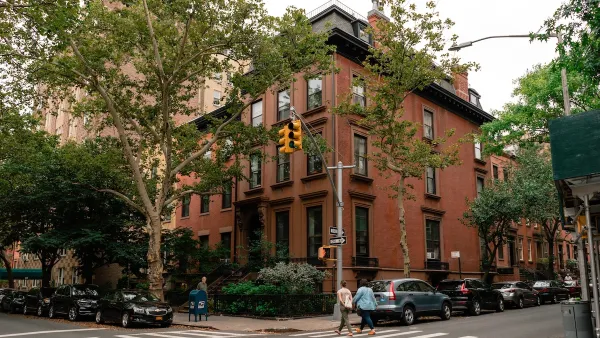
Mamdani sent nearly 6,000 pied-à-terre tax warnings to homes that didn’t qualify
A judge has ordered the administration to cancel thousands of pied-à-terre tax notices after it sent 35% of them erroneously.

Mamdani sent nearly 6,000 pied-à-terre tax warnings to homes that didn’t qualify
A judge has ordered the administration to cancel thousands of pied-à-terre tax notices after it sent 35% of them erroneously.

Detroit to transform waterfront with $2.2 billion investment
Developers will convert about 18 acres of unused parking lot space into civic spaces.

‘Going backwards:’ Baltimore mayor, students rally against state's transit funding plan
Maryland's proposed six-year plan provides no funding for Baltimore’s BMORE bus program and reduces its road maintenance funding.

FREE Course: Walkable City 1: Why Walkability?
After describing his path towards focusing on walkability as the essence of good planning, Jeff Speck marches through his five principal reasons for making more walkable places.
Reinventing Malls: Planning Alchemy—Turning Gray Fields Into Gold
The course focuses on the opportunities and imperatives that shape reinvention of mall sites.

City of Thousand Oaks
City of Wisconsin Rapids
Harvard University Graduate School of Design
The Architects Foundation
University of Cincinnati Online
Northern Illinois Transit Authority (NITA)
The Pocatello Development Authority
The Urban Renewal Agency of the City of Pocatello