


Ernest Harsch interviews UN-Habitat Director Joan Clos on the challenges facing African cities in an age of unprecedented urbanization, from the abundance of slums to the threat of natural disasters.


The problems attendant to rapid urbanization in Africa today are by no means new. Overcrowding of slums, failing infrastructure, and stunted economic development are the hallmarks of mass migrations out of the countryside and into the city. But with a projected urban population of 1.2 billion by 2050, the scale and speed of Africa's current predicament will require a new, more expedient approach to urban planning across the continent.
As urban populations skyrocket, for instance, many policies obsolesce even before they can make it through the bureaucratic framework. "The only solution is to speed up the planning process," says Clos, "because you cannot stop in-migration. If it's complex because it involves different ministries, it needs to be simplified. And if it's too dependent on central government, then it should be delegated to the local authorities."
Clos also points to the dangers that unplanned cities face with respect to natural disasters, on the rise in recent years due to accelerating climate change: "These are now typically considered to be natural disasters. But in the future they will be seen as a failure of government... We have seen earthquakes with very high tolls of victims, and similar... stronger, earthquakes elsewhere, with very few victims. The natural disaster, the quake, is the same. What is different is the outcome. "
"There are many examples (of good planning) in Africa," he points out, "but mostly at the small scale. They are not perfect, but are advancing in a good direction, in Morocco, Mauritius, Rwanda. What we still don't see is a pro-active approach, of national governments developing national urban policies to cope with the challenging future of African cities."
FULL STORY: Africa faces nightmare of urban sprawl

United Nations Taking First Steps Toward the New Urban Agenda
Some of the big work left undone by the Habitat III summit in finalizing the New Urban Agenda in December is now moving forward. The future of the New Urban Agenda and UN-Habitat can now start to take shape.

The Atlas of Urban Expansion Shows How Cities Grow
The "Monitoring Global Urban Expansion Program" gathers and analyzes data on 200 cities around the world. The "Atlas of Urban Expansion" presents the program's preliminary results.
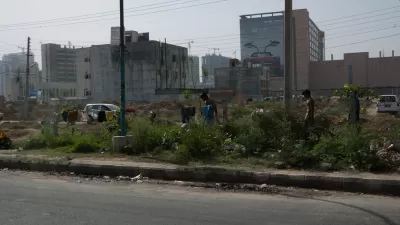
Friday Eye Candy: India's Rapid Urbanization
Photographer and architect Lars Mortensen captured the new face of urbanization in Gurgaon, a suburb of New Delhi. The scales involved are unprecedented, and rich and poor live in close proximity.

Pennsylvania Mall Conversion Bill Passes House
If passed, the bill would promote the adaptive reuse of defunct commercial buildings.

Coming Soon to Ohio: The Largest Agrivoltaic Farm in the US
The ambitious 6,000-acre project will combine an 800-watt solar farm with crop and livestock production.

World's Largest Wildlife Overpass In the Works in Los Angeles County
Caltrans will soon close half of the 101 Freeway in order to continue construction of the Wallis Annenberg Wildlife Crossing near Agoura Hills in Los Angeles County.

California Grid Runs on 100% Renewable Energy for Over 9 Hours
The state’s energy grid was entirely powered by clean energy for some portion of the day on 37 out of the last 45 days.

New Forecasting Tool Aims to Reduce Heat-Related Deaths
Two federal agencies launched a new, easy-to-use, color-coded heat warning system that combines meteorological and medical risk factors.

AI Traffic Management Comes to Dallas-Fort Worth
Several Texas cities are using an AI-powered platform called NoTraffic to help manage traffic signals to increase safety and improve traffic flow.
City of Costa Mesa
Licking County
Barrett Planning Group LLC
HUD's Office of Policy Development and Research
Mpact Transit + Community
HUD's Office of Policy Development and Research
Tufts University, Department of Urban and Environmental Policy & Planning
City of Universal City TX
ULI Northwest Arkansas

Urban Design for Planners 1: Software Tools
This six-course series explores essential urban design concepts using open source software and equips planners with the tools they need to participate fully in the urban design process.
Planning for Universal Design
Learn the tools for implementing Universal Design in planning regulations.
