


Detroit's decay epitomizes the collapse not just of the American auto industry, but the entire American consumer economy as well, writes Jennifer Wells.


"In Detroit in the Fifties, social mobility was marked not only by trading up but moving out. A traffic study conducted early in the decade forecast a 76-per-cent increase in vehicle traffic by 1980. In approving an extension of the Lodge Expressway, city burghers sealed a predictable migration to the suburbs, encouraging city dwellers to trade up and out, and, neatly, ensuring a homegrown market for the latest model car.
By failing to establish an extensive and effective inner-city transportation system, Detroit made itself the very model of social destabilization. There are those who blame the auto industry for that.
The streetcars that used to clatter down Elmore Leonard's beloved Woodward Avenue to Jefferson, where GM's headquarters looms, are long gone. There is no subway. And the in-city buses don't link up to the out-city buses. In Profile of a Metropolis, a congressman wondered, prophetically: 'Why speed the exodus from the city of the middle- and upper-income families?'
What Detroit has is the People Mover. The 50-cent, one-way skytrain that passes by the RenCen and 12 other stops downtown runs a loop that traverses a distance of a mere 2.9 miles, an easy jog. It was meant to be the linchpin for a top-of-the-line transit system. Instead it connects to nothing."
FULL STORY: The consumer dream gears down

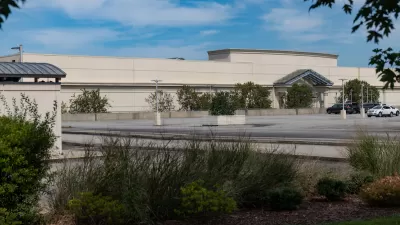
Pennsylvania Mall Conversion Bill Passes House
If passed, the bill would promote the adaptive reuse of defunct commercial buildings.
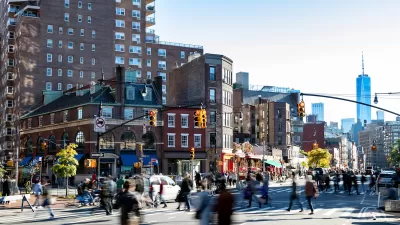
Planning for Accessibility: Proximity is More Important than Mobility
Accessibility-based planning minimizes the distance that people must travel to reach desired services and activities. Measured this way, increased density can provide more total benefits than increased speeds.
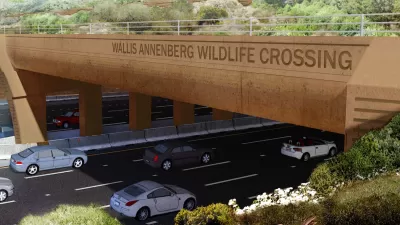
World's Largest Wildlife Overpass In the Works in Los Angeles County
Caltrans will soon close half of the 101 Freeway in order to continue construction of the Wallis Annenberg Wildlife Crossing near Agoura Hills in Los Angeles County.

Eviction Looms for Low-Income Tenants as Rent Debt Rises
Nonprofit housing operators across the country face almost $10 billion in rent debt.

Brightline West Breaks Ground
The high-speed rail line will link Las Vegas and the Los Angeles area.

Colorado Bans No-Fault Evictions
In most cases, landlords must provide a just cause for evicting tenants.
City of Costa Mesa
Licking County
Barrett Planning Group LLC
HUD's Office of Policy Development and Research
Mpact Transit + Community
HUD's Office of Policy Development and Research
Tufts University, Department of Urban and Environmental Policy & Planning
City of Universal City TX
ULI Northwest Arkansas

Urban Design for Planners 1: Software Tools
This six-course series explores essential urban design concepts using open source software and equips planners with the tools they need to participate fully in the urban design process.
Planning for Universal Design
Learn the tools for implementing Universal Design in planning regulations.
