


The extent of China's embrace of American-style suburbanization is best illustrated by one of its newest gated communities, which is actually called Orange County.


"A guard wearing a one-size-too-big military uniform salutes my driver through the gate at the grand entrance to Orange County. Suddenly we're transported from China to, well, somewhere else. Where, exactly, is hard to say. It would be strange enough if Orange County, this gated community near the Beijing airport, were the straight-up replica of Southern California it claims to be. But it is stranger than that. The development, 45 minutes up the freeway from Beijing's better-known Forbidden City, has the appearance of a Disney theme park where someone mixed up all the different sections-a smidgen of Epcot's faux Paris intermingled with Main Street U.S.A.'s Americana.
At Orange County, California-style ranch houses sit alongside English Tudors and a French-style formal garden complete with stately fountains (turned off for the winter). The street signs of weathered wood held together with rusty spikes conjure the Old West of Durango while the community clubhouse, called the Rive Gauche Town Center, has a mansard roof typical of a French country estate. The totem poles inside recall the Pacific Northwest and the fireplace mantlepiece is carved in the shape of English-language books, including Hamlet, Macbeth, and the erroneously titled Moby-Dock. So far from the West, the distinctions between France and America, let alone Colorado and California, get lost.
[Some] critics...see the development as emblematic of China's burgeoning car culture and its wholehearted embrace of environmentally destructive growth. The journalist Ted Conover tsk-tsked in The New York Times that while China rushes to build 'new gated communities, new themed enclaves, all for the car-owning class, [what is] conspicuously missing [is] a corresponding investment in mass transit, in public spaces, and public access.' As China industrializes, many fear that the country is making the same environmental mistakes the United States made a century ago, worrying that the planet cannot sustain such an onslaught from its most populous nation.
If Orange County is to be typical of development in the new China, it would seem that the world's most populous country is hurtling toward a dystopian future-and taking the rest of the planet with it."
FULL STORY: Welcome to the O.C.

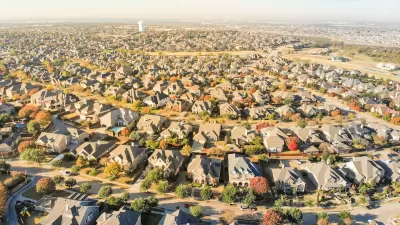
The Changing Shape of American Suburbs
Housing costs and availability are pushing more American households, including young families, to suburbs and exurbs — and they’re demanding changes.
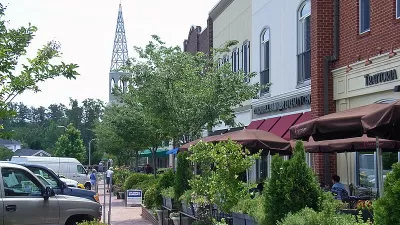
A ‘New Urbanism’ Travelogue
I visited three New Urbanist developments in North Carolina. Here's what I liked, what I didn't like, and what I learned.

Is Sprawl the Only Answer to High Housing Costs?
A recent article argues that sprawl is the solution to high housing costs, pointing out that low-density Sunbelt cities are more affordable than some more compact metro areas. What's wrong with this argument?
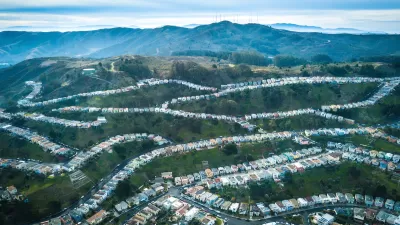
Depopulation Patterns Get Weird
A recent ranking of “declining” cities heavily features some of the most expensive cities in the country — including New York City and a half-dozen in the San Francisco Bay Area.
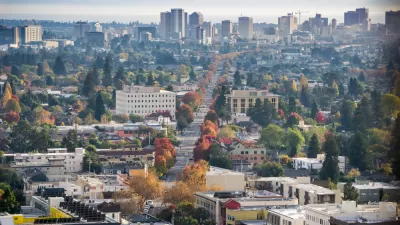
California Exodus: Population Drops Below 39 Million
Never mind the 40 million that demographers predicted the Golden State would reach by 2018. The state's population dipped below 39 million to 38.965 million last July, according to Census data released in March, the lowest since 2015.
Pennsylvania Mall Conversion Bill Passes House
If passed, the bill would promote the adaptive reuse of defunct commercial buildings.

Google Maps Introduces New Transit, EV Features
It will now be easier to find electric car charging stations and transit options.

Ohio Lawmakers Propose Incentivizing Housing Production
A proposed bill would take a carrot approach to stimulating housing production through a grant program that would reward cities that implement pro-housing policies.

Chicago Awarded $2M Reconnecting Communities Grant
Community advocates say the city’s plan may not do enough to reverse the negative impacts of a major expressway.
City of Costa Mesa
Licking County
Barrett Planning Group LLC
HUD's Office of Policy Development and Research
Mpact Transit + Community
HUD's Office of Policy Development and Research
City of Universal City TX
ULI Northwest Arkansas
Town of Zionsville

Urban Design for Planners 1: Software Tools
This six-course series explores essential urban design concepts using open source software and equips planners with the tools they need to participate fully in the urban design process.
Planning for Universal Design
Learn the tools for implementing Universal Design in planning regulations.
