


Should everyone pay for a few people to live in fire- and disaster-prone areas?


"We live with these risks because the trade-offs seem worth it. The chances of our home going up in flames or falling down a hillside seem relatively remote."
"But the magnitude of the risks was again brought into sharp focus in October, when wind-driven wildfires burned half a million acres, destroyed more than 3,000 homes, killed 10 people and temporarily displaced nearly 20,000 more from Santa Barbara to the U.S.-Mexico border. Similar destruction occurred in 2005, and climate scientists predict even more severe fire seasons ahead."
"Once the fires are put out, the official debate inevitably centers on how to respond more effectively to future conflagrations and how to better aid the victims. Last month, Gov. Arnold Schwarzenegger proposed an annual fee of 1.25% on all property insurance premiums in the state to generate, according to his office, $125 million a year for fire protection equipment and services. The state legislative analyst, Elizabeth Hill, countered that the costs should be borne by the communities that allow houses to be built in fire-hazard areas and by the people who choose to live in them."
"The disagreement boils down to two basic questions: Should local governments be allowed to continue approving development in fire-prone, or other hazardous, areas, and should all state residents keep subsidizing the choices of those who live there? Or should the state adopt rules limiting development in these areas and force the people who chose to live there to bear more of the risks?"
FULL STORY: A premium on the fire-prone

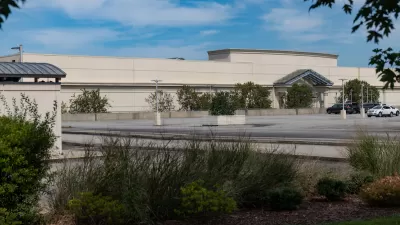
Pennsylvania Mall Conversion Bill Passes House
If passed, the bill would promote the adaptive reuse of defunct commercial buildings.

Coming Soon to Ohio: The Largest Agrivoltaic Farm in the US
The ambitious 6,000-acre project will combine an 800-watt solar farm with crop and livestock production.
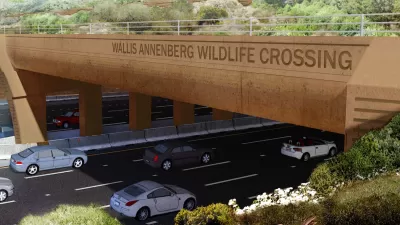
World's Largest Wildlife Overpass In the Works in Los Angeles County
Caltrans will soon close half of the 101 Freeway in order to continue construction of the Wallis Annenberg Wildlife Crossing near Agoura Hills in Los Angeles County.

California Grid Runs on 100% Renewable Energy for Over 9 Hours
The state’s energy grid was entirely powered by clean energy for some portion of the day on 37 out of the last 45 days.

New Forecasting Tool Aims to Reduce Heat-Related Deaths
Two federal agencies launched a new, easy-to-use, color-coded heat warning system that combines meteorological and medical risk factors.

AI Traffic Management Comes to Dallas-Fort Worth
Several Texas cities are using an AI-powered platform called NoTraffic to help manage traffic signals to increase safety and improve traffic flow.
City of Costa Mesa
Licking County
Barrett Planning Group LLC
HUD's Office of Policy Development and Research
Mpact Transit + Community
HUD's Office of Policy Development and Research
Tufts University, Department of Urban and Environmental Policy & Planning
City of Universal City TX
ULI Northwest Arkansas

Urban Design for Planners 1: Software Tools
This six-course series explores essential urban design concepts using open source software and equips planners with the tools they need to participate fully in the urban design process.
Planning for Universal Design
Learn the tools for implementing Universal Design in planning regulations.
