


New York mayor Michael Bloomberg's widely-touted plan for a greener city have left out the major energy consumer in Manhattan: the thousands of buildings not owned by the city.


"The streams of traffic crashing against the city's various choke points may be New York's most iconic image of waste and pollution. But, in fact, the city's buildings – its defining physical elements –account for the bulk of the New York's energy use and carbon emissions. The city's 750,000 buildings – residential, commercial and government -- are responsible for nearly 80 percent, or 47 million metric tons, of New York City's total carbon dioxide output. That's the equivalent of 150 Empire State Buildings worth of greenhouse gas being pumped annually into the atmosphere – hanging heavily over its economy, landscape and environment."
"Buildings in the city's commercial sector, alone, which includes offices and retail space, kick out 25 percent of all emissions (transportation, by contrast, accounts for 23 percent)."
"Despite this, Bloomberg's ambitious PlaNYC2030 is largely silent on reducing pollution from buildings other than those built or owned by the city. It says virtually nothing about commercial buildings. Can New York City expect to meet its goal of reducing overall emissions by 30 percent by 2030 if it does not move aggressively – like London – to encourage and, in certain cases, impose efficiency standards on commercial property, one of its largest polluting sectors?"
FULL STORY: Cleaning Up New York’s Buildings

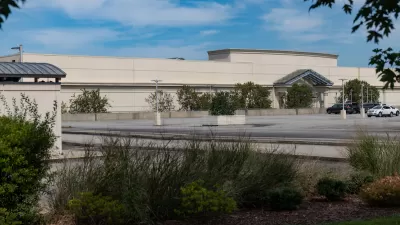
Pennsylvania Mall Conversion Bill Passes House
If passed, the bill would promote the adaptive reuse of defunct commercial buildings.

Depopulation Patterns Get Weird
A recent ranking of “declining” cities heavily features some of the most expensive cities in the country — including New York City and a half-dozen in the San Francisco Bay Area.

California Exodus: Population Drops Below 39 Million
Never mind the 40 million that demographers predicted the Golden State would reach by 2018. The state's population dipped below 39 million to 38.965 million last July, according to Census data released in March, the lowest since 2015.

Google Maps Introduces New Transit, EV Features
It will now be easier to find electric car charging stations and transit options.

Ohio Lawmakers Propose Incentivizing Housing Production
A proposed bill would take a carrot approach to stimulating housing production through a grant program that would reward cities that implement pro-housing policies.

Chicago Awarded $2M Reconnecting Communities Grant
Community advocates say the city’s plan may not do enough to reverse the negative impacts of a major expressway.
City of Costa Mesa
Licking County
Barrett Planning Group LLC
HUD's Office of Policy Development and Research
Mpact Transit + Community
HUD's Office of Policy Development and Research
City of Universal City TX
ULI Northwest Arkansas
Town of Zionsville

Urban Design for Planners 1: Software Tools
This six-course series explores essential urban design concepts using open source software and equips planners with the tools they need to participate fully in the urban design process.
Planning for Universal Design
Learn the tools for implementing Universal Design in planning regulations.
