


With ridership on the only commercially operating maglev line far below expectations, the much admired technology might be in danger of extinction.


"Shanghai spent $1.25 billion building the world's fastest train, running from the city to Pudong International Airport. Cindy Huang would rather catch a bus.
The fare - 50 yuan, or $6.60 - is too high for most residents of Shanghai, said Huang, a human resources officer. And the magnetic-levitation, or maglev, line terminates in Pudong's suburbs, 12 kilometers, or 7.5 miles, from downtown, meaning most travelers must get other transportation to reach their final destinations.
"It's much more expensive and time consuming to take it," said Huang, who has made 11 trips on the 431 kilometer-per-hour train, mostly escorting visitors to the city, a financial hub of China. "It's not my choice, if I travel on my own."
The Shanghai authorities have put on hold plans to spend $5.3 billion to extend the 30-kilometer line - the world's only commercial maglev train.
The project has been plagued by low passengers numbers - fewer than a quarter of what were expected - protests by residents concerned about radiation and construction costs twice as high as those for other high speed trains. Cancellation could force Siemens and ThyssenKrupp, the developers, to scrap the 73-year-old technology and write off at least $2 billion in costs, said Gerd Aberle, a professor of transportation economics at Giessen University in Germany.
"It's the last chance to convince the rest of the world that the maglev is an interesting system," he said. "If it's not realized in China, that may be the end.""
FULL STORY: Shanghai's fast train catches on only slowly

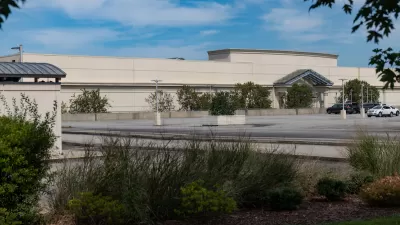
Pennsylvania Mall Conversion Bill Passes House
If passed, the bill would promote the adaptive reuse of defunct commercial buildings.

Coming Soon to Ohio: The Largest Agrivoltaic Farm in the US
The ambitious 6,000-acre project will combine an 800-watt solar farm with crop and livestock production.
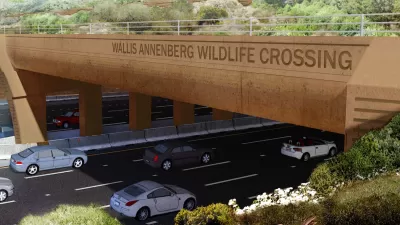
World's Largest Wildlife Overpass In the Works in Los Angeles County
Caltrans will soon close half of the 101 Freeway in order to continue construction of the Wallis Annenberg Wildlife Crossing near Agoura Hills in Los Angeles County.

California Grid Runs on 100% Renewable Energy for Over 9 Hours
The state’s energy grid was entirely powered by clean energy for some portion of the day on 37 out of the last 45 days.

New Forecasting Tool Aims to Reduce Heat-Related Deaths
Two federal agencies launched a new, easy-to-use, color-coded heat warning system that combines meteorological and medical risk factors.

AI Traffic Management Comes to Dallas-Fort Worth
Several Texas cities are using an AI-powered platform called NoTraffic to help manage traffic signals to increase safety and improve traffic flow.
City of Costa Mesa
Licking County
Barrett Planning Group LLC
HUD's Office of Policy Development and Research
Mpact Transit + Community
HUD's Office of Policy Development and Research
Tufts University, Department of Urban and Environmental Policy & Planning
City of Universal City TX
ULI Northwest Arkansas

Urban Design for Planners 1: Software Tools
This six-course series explores essential urban design concepts using open source software and equips planners with the tools they need to participate fully in the urban design process.
Planning for Universal Design
Learn the tools for implementing Universal Design in planning regulations.
