


President Bush has often looked toward American technology to make voluntary carbon emission reductions, but that technology often must come from abroad, where industrialized countries are required to make emission reductions per the Kyoto Protocol.


"Numerous wind-power projects from Virginia to California have been stalled due to the shortage. But for some renewable-energy companies in Europe, where wind power has been in vogue for almost two decades, the logjam is a lucrative opportunity. These firms anticipated a shortage of turbines and locked in orders with makers. They're now using their considerable buying power to gobble up smaller utilities in the U.S. that couldn't otherwise get their hands on turbines."
"In the U.S., more wind power was installed last year than in any country in the world -- 2,454 megawatts, or more than the equivalent of two nuclear reactors. Despite the recent action, the U.S. still lags behind other countries that have spent decades nurturing wind power with subsidies and price supports. Germany has fewer wind resources -- breezy, wide-open spaces -- than the state of North Dakota, for instance, but has twice as much wind power as the entire U.S. Spain, with one-seventh the population of the U.S., has the same amount of wind power. Overall, only about 1% of power in the U.S. comes from wind."
"The biggest restriction right now to wind power's growth -- everywhere, not just in the U.S. -- is the lack of turbines", states Miguel Salis, the head of the Madrid-based Eolia, a fund that supplies financing and development know-how to small wind-farm developers.
"In the U.S., there's another potential threat to growth -- erratic government support for wind power. Even though wind power has made technical strides recently, energy firms still rely on subsidies because it costs more to generate electricity with wind turbines than other power plants such as coal, natural gas or nuclear. Wind power requires intensive capital investment in a short period of time, and has added costs like upgrading transmission systems. According to the International Energy Agency in Paris, wind farms cost between four and 14 cents to generate a kilowatt hour; coal-fired plants cost between 2.5 and six cents."
[Editor's note: Although this article is only available to WSJ subscribers, it is available to Planetizen readers for free through the link below for a period of seven days.]
FULL STORY: Alternative Energy Hurt By a Windmill Shortage

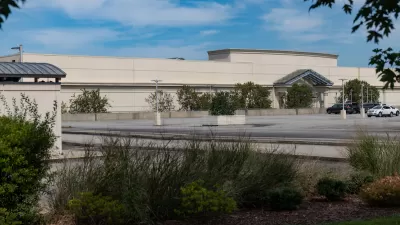
Pennsylvania Mall Conversion Bill Passes House
If passed, the bill would promote the adaptive reuse of defunct commercial buildings.
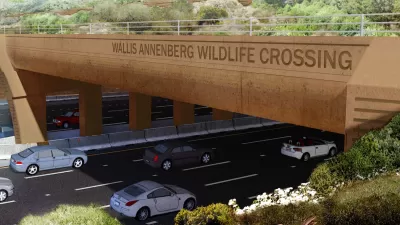
World's Largest Wildlife Overpass In the Works in Los Angeles County
Caltrans will soon close half of the 101 Freeway in order to continue construction of the Wallis Annenberg Wildlife Crossing near Agoura Hills in Los Angeles County.

U.S. Supreme Court: California's Impact Fees May Violate Takings Clause
A California property owner took El Dorado County to state court after paying a traffic impact fee he felt was exorbitant. He lost in trial court, appellate court, and the California Supreme Court denied review. Then the U.S. Supreme Court acted.

Indy Bikeshare System Turns 10, Expands to E-Bikes
Pacers Bikeshare riders logged over 700,000 rides since the system launched in 2014.

Coming Soon to Ohio: The Largest Agrivoltaic Farm in the US
The ambitious 6,000-acre project will combine an 800-watt solar farm with crop and livestock production.

New York’s Deadliest Neighborhoods for Pedestrians
Pedestrian deaths rose last year, but remain below pre-2020 levels.
City of Costa Mesa
Licking County
Barrett Planning Group LLC
HUD's Office of Policy Development and Research
Mpact Transit + Community
HUD's Office of Policy Development and Research
Tufts University, Department of Urban and Environmental Policy & Planning
City of Universal City TX
ULI Northwest Arkansas

Urban Design for Planners 1: Software Tools
This six-course series explores essential urban design concepts using open source software and equips planners with the tools they need to participate fully in the urban design process.
Planning for Universal Design
Learn the tools for implementing Universal Design in planning regulations.
