


Do yourself a favor: Go check out the latest issue of IEEE Spectrum, either online or in hard copy. Spectrum is the trade magazine for the international engineers' society—it's really quite good—and this issue features an extensive package on megacities.This is the engineer's take on many of the issues we all grapple with on Interchange. So it's not about making public meetings go more smoothly or trying to understand how to use GIS for placemaking. It's about building stuff and making sure it'll keep working.


 Do yourself a favor: Go check out the latest issue of IEEE Spectrum, either online or in hard copy. Spectrum is the trade magazine for the international engineers' society-it's really quite good-and this issue features an extensive package on megacities.
This is the engineer's take on many of the issues we all grapple with on Interchange. So it's not about making public meetings go more smoothly or trying to understand how to use GIS for placemaking. It's about building stuff and making sure it'll keep working.
There's too much in the issue to pick out one or two things to link to. Great stuff on electrical infrastructure, earthquake preparedness, surveillance, terrific (and terrifically useful) statistics...hoo, boy. I haven't even made it half way through, and I'm psyched.
I'll leave off, then, with this wonderful chart showing the ecological footprint-all the inputs and outputs-of greater London. And check out the way the writer, Samuel K. Moore, tees it up:
Greater London, like all metropolitan areas, is a living thing. Each year it eats-7 million metric tons of food. It drinks-94 million liters of bottled water alone. It breathes-giving off 41 million metric tons of carbon dioxide. It excretes-generating 26 million metric tons of garbage. It builds itself up with 28million metric tons of cement, glass, and other construction materials. And it falls apart, generating 15 million metric tons of debris from demolished buildings.


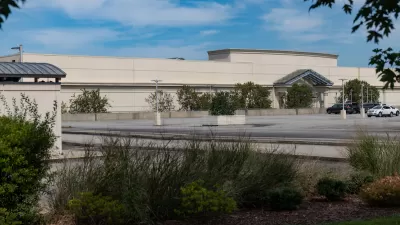
Pennsylvania Mall Conversion Bill Passes House
If passed, the bill would promote the adaptive reuse of defunct commercial buildings.

Coming Soon to Ohio: The Largest Agrivoltaic Farm in the US
The ambitious 6,000-acre project will combine an 800-watt solar farm with crop and livestock production.
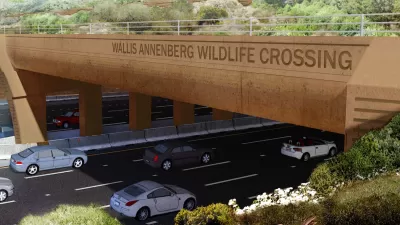
World's Largest Wildlife Overpass In the Works in Los Angeles County
Caltrans will soon close half of the 101 Freeway in order to continue construction of the Wallis Annenberg Wildlife Crossing near Agoura Hills in Los Angeles County.

California Grid Runs on 100% Renewable Energy for Over 9 Hours
The state’s energy grid was entirely powered by clean energy for some portion of the day on 37 out of the last 45 days.

New Forecasting Tool Aims to Reduce Heat-Related Deaths
Two federal agencies launched a new, easy-to-use, color-coded heat warning system that combines meteorological and medical risk factors.

AI Traffic Management Comes to Dallas-Fort Worth
Several Texas cities are using an AI-powered platform called NoTraffic to help manage traffic signals to increase safety and improve traffic flow.
City of Costa Mesa
Licking County
Barrett Planning Group LLC
HUD's Office of Policy Development and Research
Mpact Transit + Community
HUD's Office of Policy Development and Research
Tufts University, Department of Urban and Environmental Policy & Planning
City of Universal City TX
ULI Northwest Arkansas

Write for Planetizen


Urban Design for Planners 1: Software Tools
This six-course series explores essential urban design concepts using open source software and equips planners with the tools they need to participate fully in the urban design process.
Planning for Universal Design
Learn the tools for implementing Universal Design in planning regulations.
