


The aftermath of Hurricane Katrina reveals significant population shifts, huge losses for insurance companies, and a collapse in real estate values.


"In some Mississippi Gulf Coast towns, Katrina's powerful 28-foot-high storm surge did not leave a single structure standing. There was nothing for evacuees to return to. The destruction of housing and infrastructure in St. Bernard Parish, a low-lying 40-mile-long peninsula extending southeast from New Orleans, rendered most of it uninhabitable.
Many evacuees were able to return in a matter of days, but many more were not. New Orleans' population before Katrina struck was 463,000. Claritas, a private demographic data-gathering and analysis firm, reported that after the hurricane New Orleans' population shrank to 93,000. By January 2006, it had recovered to 174,000. By July 2006, the city still had only 214,000 residents, less than half of its pre-Katrina population.
...After a point -- as storm risks multiply and insurance rates rise -- real estate prices start to decline. To cite an extreme example, how much is a building lot worth in St. Bernard Parish, now largely abandoned, or in the low-lying parts of New Orleans?
As rising seas and more powerful hurricanes translate into higher insurance costs in these coastal communities, people are retreating inland. And just as companies migrate to regions with lower wages, they also migrate to regions with lower insurance costs."
FULL STORY: America's Eco-Refugees

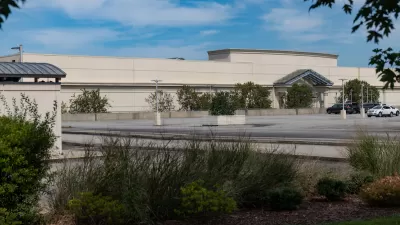
Pennsylvania Mall Conversion Bill Passes House
If passed, the bill would promote the adaptive reuse of defunct commercial buildings.

World's Largest Wildlife Overpass In the Works in Los Angeles County
Caltrans will soon close half of the 101 Freeway in order to continue construction of the Wallis Annenberg Wildlife Crossing near Agoura Hills in Los Angeles County.

U.S. Supreme Court: California's Impact Fees May Violate Takings Clause
A California property owner took El Dorado County to state court after paying a traffic impact fee he felt was exorbitant. He lost in trial court, appellate court, and the California Supreme Court denied review. Then the U.S. Supreme Court acted.

California Grid Runs on 100% Renewable Energy for Over 9 Hours
The state’s energy grid was entirely powered by clean energy for some portion of the day on 37 out of the last 45 days.

New Forecasting Tool Aims to Reduce Heat-Related Deaths
Two federal agencies launched a new, easy-to-use, color-coded heat warning system that combines meteorological and medical risk factors.

AI Traffic Management Comes to Dallas-Fort Worth
Several Texas cities are using an AI-powered platform called NoTraffic to help manage traffic signals to increase safety and improve traffic flow.
City of Costa Mesa
Licking County
Barrett Planning Group LLC
HUD's Office of Policy Development and Research
Mpact Transit + Community
HUD's Office of Policy Development and Research
Tufts University, Department of Urban and Environmental Policy & Planning
City of Universal City TX
ULI Northwest Arkansas

Urban Design for Planners 1: Software Tools
This six-course series explores essential urban design concepts using open source software and equips planners with the tools they need to participate fully in the urban design process.
Planning for Universal Design
Learn the tools for implementing Universal Design in planning regulations.
