


Suburban growth patterns are among a host of factors considered detrimental to public health in several recent stories featured in the Australian media.


"The results are nearly in. Half a century of postwar growth - driven by escalating production, and flavoured by hard-core consumption and mass migration to cities - is yielding a consistent global pattern."
Living in cities can be deadly.
"Cities are hymns to hyper-consumption, and from this year, for the first time, more than half the world's population will live in one. But Australia is well ahead of that trend. Three-quarters of us live in cities, says the Australian Bureau of Statistics, and the urban population is gaining four times as many people annually as regional Australia. Sydney alone gains 30,000 residents a year."
"Cities are only there because they're supposed to be useful to people. When they start to have more negatives to people than positives you have to stop and think," says Pieta Laut, the executive director of the Public Health Association of Australia. "We can sustain human life in some of the cruddiest environments, and always have. We need to get beyond what we can survive in, but what's good for a community...cities will not become untenable but they'll get nastier and nastier."
Thanks to D. A. Varnado, AICP
FULL STORY: Killer Cities

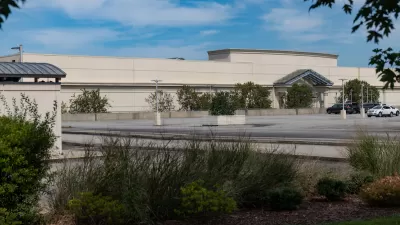
Pennsylvania Mall Conversion Bill Passes House
If passed, the bill would promote the adaptive reuse of defunct commercial buildings.

Planning for Accessibility: Proximity is More Important than Mobility
Accessibility-based planning minimizes the distance that people must travel to reach desired services and activities. Measured this way, increased density can provide more total benefits than increased speeds.

World's Largest Wildlife Overpass In the Works in Los Angeles County
Caltrans will soon close half of the 101 Freeway in order to continue construction of the Wallis Annenberg Wildlife Crossing near Agoura Hills in Los Angeles County.

Eviction Looms for Low-Income Tenants as Rent Debt Rises
Nonprofit housing operators across the country face almost $10 billion in rent debt.

Brightline West Breaks Ground
The high-speed rail line will link Las Vegas and the Los Angeles area.

Colorado Bans No-Fault Evictions
In most cases, landlords must provide a just cause for evicting tenants.
City of Costa Mesa
Licking County
Barrett Planning Group LLC
HUD's Office of Policy Development and Research
Mpact Transit + Community
HUD's Office of Policy Development and Research
Tufts University, Department of Urban and Environmental Policy & Planning
City of Universal City TX
ULI Northwest Arkansas

Urban Design for Planners 1: Software Tools
This six-course series explores essential urban design concepts using open source software and equips planners with the tools they need to participate fully in the urban design process.
Planning for Universal Design
Learn the tools for implementing Universal Design in planning regulations.
