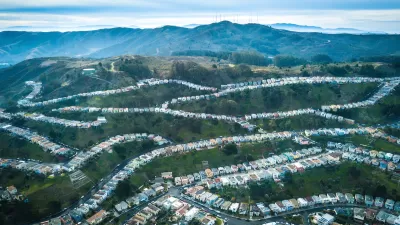
Is Infill Development Just Vertical Sprawl?

8 August 2006 - 11:00am

Opponents of high density development argue that urban infill causes just as many problems as traditional sprawl.

Just as many cities are seeing a turnaround--where many older, declining neighborhoods are finally attracting new investment—-some residents of these communities are objecting to the blast of higher density land use being injected into their streets.

Planners and politicians see smart growth as efficient and environmentally sound. Yet, critics call the new projects "vertical sprawl"--and blame the developments for the displacement of long time residents and gentrification of neighborhoods.

Source: The New York Times, August 6, 2006

Comment viewing options

Select your preferred way to display the comments and click "Save settings" to activate your changes.

Key Word is "Smart" in Smart Growth

I don't like this article because it tries to paint Smart Growth as this new phenomenom that is to blame for some planners poor decision making. I understand that some neighborhoods don't deserve the tall buildings being built next to them. I also think gentrification is a serious issue that many planners tend to forget about while their city progresses. But to blame Smart Growth is just wrong. The word "smart" is in there for a reason. Planners need to weigh the pros and cons of any decision. Just because it is infill doesn't mean it fits into the Smart Growth ideals.

Being Genuinely Smart about Smart growth

The issue here is what gets into planners' field of vision, what is considered an issue worthy of concern. Often gentrification is dismissed as a non-physical or (worse) "political" concern, not appropriate for discussion in the staff report about the proposed new highrise. But what question is more fundamental than who will live in a neighborhood? To be smarter, smart growth needs to be broader.

Vertical Sprawl an Oxymoron

I disagree with many of the premises of this article, but the part with which I have the greatest qualms is the term "vertical sprawl." It is an oxymoron. Perhaps it is possible that an area can grow too densely, and that buildings can be built too high in relation to the surrounding city. James Hillman writes in his work "City and Soul":

"The deeper meanings, the deeper complexities of something, so that each time you look at it to enter it, it takes on another level of significance....There's always danger...if one goes up only, that is, if one emphasizes skylines, towers, and does not keep the heights relative to depths."

Thus, a balance must be achieved between the ratio of height to area. While no given formula for this exists, common sense and a willingness to view the built environment with a critical eye, taking into account economic and cultural needs, can often reveal the correct balance.

That said, even too great an emphasis on height should not be termed "sprawl." The definition of sprawl is "To spread out in a straggling or disordered fashion." Tall buildings can extend in only one direction, while something that sprawls must, by definition, extend in many directions. Complaints of buildings that are too tall can be justified (though rarely), but calling it "vertical sprawl" cannot.

"vertical sprawl." It is an oxymoron....

Caitlin.Greeley wrote, "I disagree with many of the premises of this article, but the part with which I have the greatest qualms is the term "vertical sprawl." It is an oxymoron....

(Caitlin continued:
"That said, even too great an emphasis on height should not be termed 'sprawl.' The definition of sprawl is 'To spread out in a straggling or disordered fashion.' Tall buildings can extend in only one direction, while something that sprawls must, by definition, extend in many directions. Complaints of buildings that are too tall can be justified (though rarely), but calling it 'vertical sprawl' cannot." (end quote).

So the closing of the article, "Which means the war over vertical sprawl may have just begun." is completely inappropriate....why not simply call it the war against height and infill and density?

Thank you, Caitlin, for articulating my objections to the coining of that awkward term, verticle sprawl, better than I could have stated!

Irvin Dawid, Palo Alto, CA

What's the answer to vertical sprawl talking point?

I agree Irwin.

What is important to remember, however, is that the opposition has a catchy term to implant in the public mind. And that they'll use it, over and over, until it is a standard term, like 'wise use'. We should have an answer ready.

Best,

D

Nothing New About Opposition to Infill

This article may be fit to print, but it is not news. Neighborhood groups have opposed infill for decades.

The article mentions Berkeley as an example of extreme opposition to infill:

There’s often little correlation between a proposal’s size and the depth of the opposition to it. In Berkeley, Calif., intense controversy has erupted over plans to turn a single parking lot next to a subway station into a 300-unit apartment and retail complex. “There seems to be an almost religious objection to height,” said Mr. Droettboom. “People say, ‘It’s just too tall.’ ”

As a long-time Berkeley resident, I know that that opposition to infill was even stronger in the 1970s. Back then, it was strong enough to stop most new development. The difference today is that infill projects in Berkeley are supported by environmentalists who back smart growth as well as being opposed by NIMBYs. The NIMBYs have been saying the same thing since the 1970s, and the smart-growth environmentalists did not join the battle until the 1990s.

The same is true nation-wide. The term "smart growth" was invented in the 1990s, and NIMBYs have been on the defensive ever since. The writer of this article simply doesn't know the history of the subject.

Charles Siegel

Bookmark and Share
Local zoning rules don’t have to be fixed – we can design them to change with the times in those neighborhoods where change is wanted.