


Trains have played a large role in shaping America's past, and will have a big impact on her future as rail transit continues to change the way we think about urban growth.


In an article published in the latest issue of The Next American City, the varying impacts of rail transit on old and new American cities is compared. The authors recommend that western cities have an important opportunity to use transit as an effective planning tool, rather than just a response to existing conditions. .
"Light rail has the potential to transform the transportation habits of hundreds of thousands of users. Additionally, by decreasing congestion, conserving fuel, and reducing emissions, transit creates a public good that benefits even those who choose not to use it. Already, light rail has had a significant impact in the West. In some places, like Portland, it has affected new development, with Metropolitan Area Express (MAX) light rail lines expanding into previously undeveloped areas and shaping those areas’ characteristics."
"In many metropolitan areas, transportation planners find themselves in a position of reacting to sprawl and its related congestion problems, producing public transportation systems that fail to capitalize on their potential to shape future development patterns and instead try to get people living amongst sprawl to use transit. Some Metrorail stationsâ€"Shady Grove, at the northwest end of the Red Line in Maryland, for exampleâ€"have followed this example, focusing on herding commuters from surrounding areas to massive park-and-ride lots. But along most of the Metrorail, Washington-area planners have taken a different route, encouraging stations to serve as catalysts for development or redevelopment of surrounding neighborhoods."
Thanks to David Godfrey
FULL STORY: Along the Tracks: a Tale of Transit and Development


Coming Soon to Ohio: The Largest Agrivoltaic Farm in the US
The ambitious 6,000-acre project will combine an 800-watt solar farm with crop and livestock production.
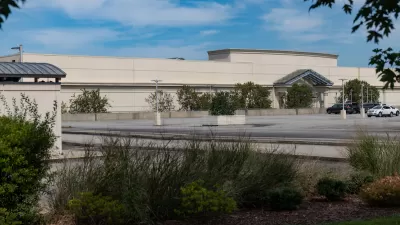
Pennsylvania Mall Conversion Bill Passes House
If passed, the bill would promote the adaptive reuse of defunct commercial buildings.

U.S. Supreme Court: California's Impact Fees May Violate Takings Clause
A California property owner took El Dorado County to state court after paying a traffic impact fee he felt was exorbitant. He lost in trial court, appellate court, and the California Supreme Court denied review. Then the U.S. Supreme Court acted.

Dallas Surburb Bans New Airbnbs
Plano’s city council banned all new permits for short-term rentals as concerns about their impacts on housing costs grow.

Divvy Introduces E-Bike Charging Docks
New, circular docks let e-bikes charge at stations, eliminating the need for frequent battery swaps.

How Freeway Projects Impact Climate Resilience
In addition to displacement and public health impacts, highway expansions can also make communities less resilient to flooding and other climate-related disasters.
City of Costa Mesa
Licking County
Barrett Planning Group LLC
HUD's Office of Policy Development and Research
Mpact Transit + Community
HUD's Office of Policy Development and Research
Tufts University, Department of Urban and Environmental Policy & Planning
City of Universal City TX
ULI Northwest Arkansas

Urban Design for Planners 1: Software Tools
This six-course series explores essential urban design concepts using open source software and equips planners with the tools they need to participate fully in the urban design process.
Planning for Universal Design
Learn the tools for implementing Universal Design in planning regulations.
