


The emerging and controversial Israeli barrier wall is in some ways a model of planning reduced to its most primitive goal: separation.


"...[T]he proposed 725-kilometer, or 450-mile, barrier is a model of planning reduced to its most primitive -- the desire to divide black from white, us from them. Conceived in 2002 to protect Israel from terrorists, it has been extolled as a necessary tool for self-preservation. It has also been assailed as a formula for ghettoization and a symbol of colonialism.
But on a fundamental level, it is also a piece of architecture. And its construction has generated an architectural debate as charged as any in the political realm.
That debate has pitted strategists who mine the leftist architectural theories of the 1960s for ideas on contemporary urban warfare against architects who see the barrier as a perversion of those ideas, along with the utopian visions of Modernists who believed society's problems could be solved with concrete, glass and steel. It is not only unfolding in the halls of academia but in Israeli and American military circles. And it presents a vision of the wall as a system of complex, interweaving spaces - some concrete, some invisible - that is far from our normal perception of an international border."
FULL STORY: As Israeli barrier goes up, views harden on all sides

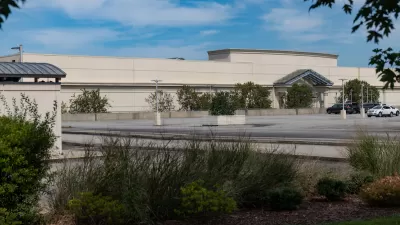
Pennsylvania Mall Conversion Bill Passes House
If passed, the bill would promote the adaptive reuse of defunct commercial buildings.

Planning for Accessibility: Proximity is More Important than Mobility
Accessibility-based planning minimizes the distance that people must travel to reach desired services and activities. Measured this way, increased density can provide more total benefits than increased speeds.
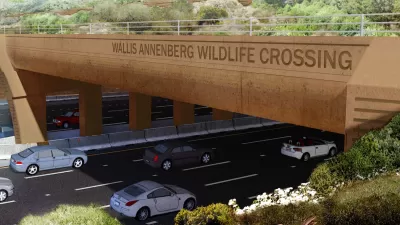
World's Largest Wildlife Overpass In the Works in Los Angeles County
Caltrans will soon close half of the 101 Freeway in order to continue construction of the Wallis Annenberg Wildlife Crossing near Agoura Hills in Los Angeles County.

Eviction Looms for Low-Income Tenants as Rent Debt Rises
Nonprofit housing operators across the country face almost $10 billion in rent debt.

Brightline West Breaks Ground
The high-speed rail line will link Las Vegas and the Los Angeles area.

Colorado Bans No-Fault Evictions
In most cases, landlords must provide a just cause for evicting tenants.
City of Costa Mesa
Licking County
Barrett Planning Group LLC
HUD's Office of Policy Development and Research
Mpact Transit + Community
HUD's Office of Policy Development and Research
Tufts University, Department of Urban and Environmental Policy & Planning
City of Universal City TX
ULI Northwest Arkansas

Urban Design for Planners 1: Software Tools
This six-course series explores essential urban design concepts using open source software and equips planners with the tools they need to participate fully in the urban design process.
Planning for Universal Design
Learn the tools for implementing Universal Design in planning regulations.
