


Nineteen years after the radioactive explosion in Chernobyl, the ecosystem has returned, and with greater biodiversity than before.


Though the region won't be safe for human habitation for hundreds of thousands of years, animals and plants there appear to be thriving. It's "evolution on steroids," said one excited ecologist, "a fantastic experiment."
"How has this happened, given that radiation levels are still too high for humans to return safely? Morris thinks that many of the organisms mutated by the fallout have died, leaving behind those that have not suffered problems with growth and reproduction. "It's evolution on steroids. There are a lot of deleterious mutations in species but these seem to be very quickly weeded out," Morris explains. Many young fish living in the reactor's cooling ponds are deformed, but adults tend to be healthy, implying that those harmed by radiation die young."
Thanks to Chris Steins
FULL STORY: Chernobyl ecosystems 'remarkably healthy'


Depopulation Patterns Get Weird
A recent ranking of “declining” cities heavily features some of the most expensive cities in the country — including New York City and a half-dozen in the San Francisco Bay Area.
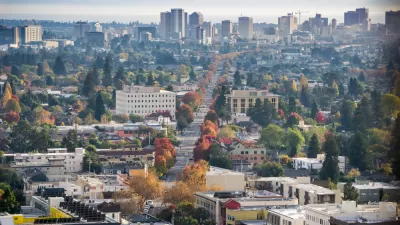
California Exodus: Population Drops Below 39 Million
Never mind the 40 million that demographers predicted the Golden State would reach by 2018. The state's population dipped below 39 million to 38.965 million last July, according to Census data released in March, the lowest since 2015.

Chicago to Turn High-Rise Offices into Housing
Four commercial buildings in the Chicago Loop have been approved for redevelopment into housing in a bid to revitalize the city’s downtown post-pandemic.

New Park Opens in the Santa Clarita Valley
The City of Santa Clarita just celebrated the grand opening of its 38th park, the 10.5-acre Skyline Ranch Park.

U.S. Supreme Court: California's Impact Fees May Violate Takings Clause
A California property owner took El Dorado County to state court after paying a traffic impact fee he felt was exorbitant. He lost in trial court, appellate court, and the California Supreme Court denied review. Then the U.S. Supreme Court acted.

How Urban Form Impacts Housing Affordability
The way we design cities affects housing costs differently than you might think.
City of Costa Mesa
Licking County
Barrett Planning Group LLC
HUD's Office of Policy Development and Research
Mpact Transit + Community
HUD's Office of Policy Development and Research
City of Universal City TX
ULI Northwest Arkansas
Town of Zionsville

Urban Design for Planners 1: Software Tools
This six-course series explores essential urban design concepts using open source software and equips planners with the tools they need to participate fully in the urban design process.
Planning for Universal Design
Learn the tools for implementing Universal Design in planning regulations.
